What if I lose my job? If I lose my job then, I won’t be able to pay rent or afford food. Then I’ll have to move back in with my parents, or worse!- I’ll be homeless. I can’t get fired, oh please god, I need this job or I’m in real trouble. What if I do lose it though? I won’t be able to pay off my debt either, then I’ll get even more interest or I’ll damage my credit, and I’ll be in a financial hole for the rest of my life.
These thoughts may seem a little excessive to some people, but many of us have had worries like this countless times – usually when our guard is down, when we are tired, lying in bed with nothing to distract us. What is it about worry that can be so difficult to control? Researchers Rodebaugh and Heimberg suggest that worry “acts as a trick the person is playing on himself or herself to provide the illusion of action, when useful action seems impossible.” In other words, in our minds, worry resembles problem solving or planning. We convince ourselves that if we just worry enough, we will be better able to prevent “something bad” from happening or we will be better able to cope if this “something bad” does happen.
However, worry is not problem solving or planning. Worry is simply thinking about a problem or fear, it is not a productive attempt to create solutions. Worry typically leads to anxiety, which is a physical reaction priming your body to deal with threats, it is preparing you to run away and/or fight. Now in some situations this is helpful, but in the vast majority of situations in modern society, we do not need to run away or fight. Therefore, this is an inappropriate and unnecessary reaction. Sometimes the first step in overcoming worry is actually accepting that worrying is not helping us. Moreover, in many situations worrying, and the associated anxiety, is actually reducing our ability to cope with challenges. Many clients enter therapy and want to get rid of the suffering cause by anxiety without having to stop worrying, but this is an unrealistic expectation. So long as we keep our pattern of worrying, we will keep our pattern of feeling anxious.
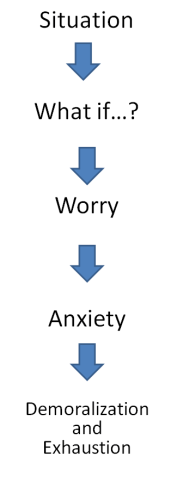
There are several different types of anxiety. One such type is called “generalized anxiety.” People that struggle with generalized anxiety worry more than most people about everyday things, and have trouble controlling it. Generalized anxiety can keep you awake at night or make you feel sick. Sometimes people with generalized anxiety refer to themselves as “worriers.” The Cognitive Model of Generalized Anxiety Disorder, created by Dugas and Robichaud, illustrates the connection between situations, wondering “what if something bad happens?”, worry, anxiety, and demoralization/exhaustion.
So if we accept that worry is not particularly helpful for us, and we want to change this pattern of worrying, what can we do?
According to many CBT therapists, the first step in overcoming anxiety is understanding our worries. We can do this by writing down what we are worried about several times throughout the day. Then you take this list of worries and divide them into actual current problems and hypothetical “what if…?” worries.
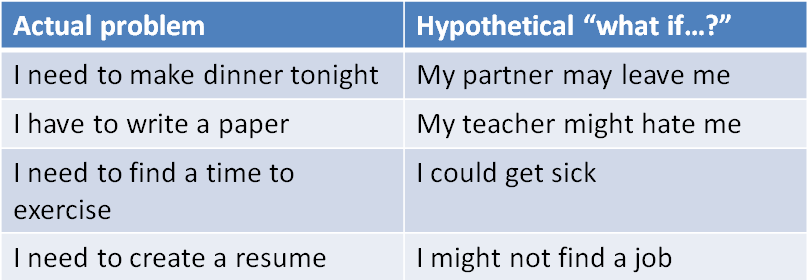
Now you might look at this list and think “but I could get sick!” or “but my partner might leave me!” Yes, but in neither of these situations will worrying help problem solve. You might also look at these lists and think “but my worrying helps motivate me! If I quit worrying, won’t I lose my motivation??” Let me answer this question with a question – many, many, many very motivated and successful people do not worry very much, so why do you have to play by different rules? Also, we can problem solve, set goals, and plan all without worrying, don’t get sucked into the tricks worrying is trying to play on you. One huge difference between the things in the “actual problem” category is that the things on that list are current and actionable. You can choose to make something for dinner, choose to write a paper, choose to schedule a time to exercise, and choose to create a resume. The things on the “what if…?” list are uncertain because they are in the future and greatly influenced by forces beyond your control. It would be a beautiful world if we could just choose to not get sick or choose to have everyone like you.
God grant me the serenity to accept the things I cannot change,
Courage to change the things I can,
And the wisdom to know the difference.
The Serenity Prayer.
In the sections above, I suggested that worrying is not problem solving, this begs the question “what is problem solving?” In problem solving we first (a) identify the problem, (b) identify possible solutions to a problem, (c) evaluate the pros and cons of each solution, (d) select a reasonably good solution, (e) try it out, (f) evaluate how the solution worked to solve the problem, and (g) repeat this process as necessary. I strongly recommend you write these steps down for your more serious concerns, or chances are when you worry about the problem at 2 in the morning you won’t remember the plan to created yesterday to solve the problem.
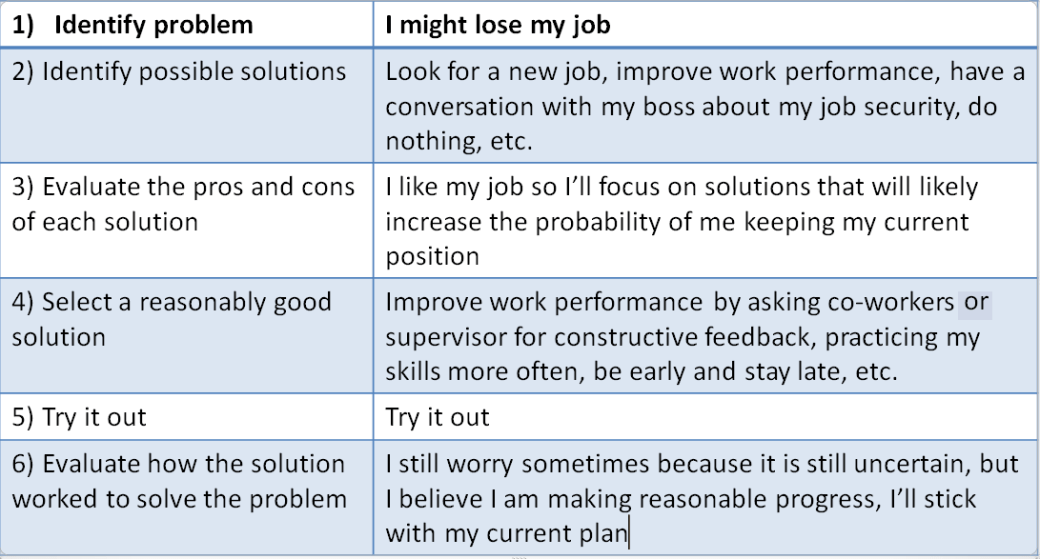
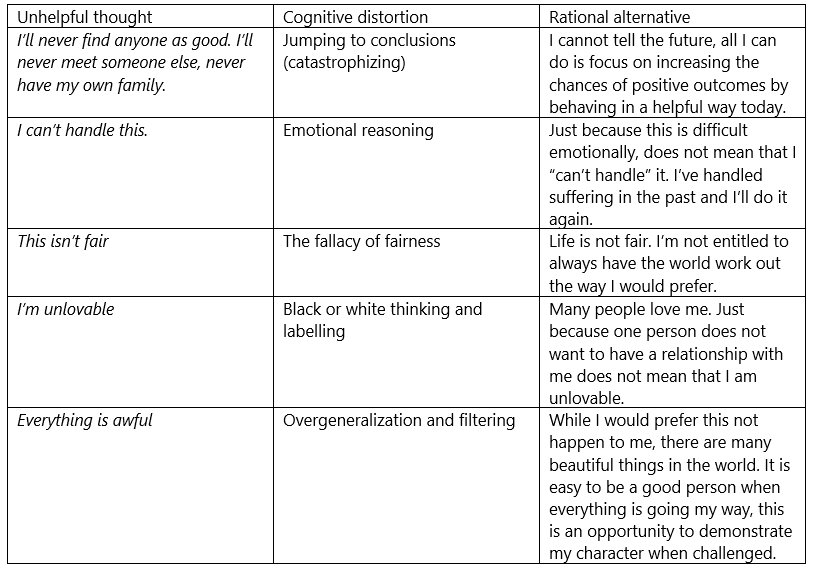
The exercise of identifying which worries are actual problems that we can do something about, from those worries that are beyond our control can be a powerful tool for challenging unhelpful thinking patterns. As we become more aware of these unhelpful patterns, we can replace unhelpful thoughts with more helpful ones. When we think “I might lose my job” we can challenge this worry by thinking “yes, it is possible, however I cannot control this. Instead I’m going to focus on things I can do to decrease the probability of this happening – such as improving my performance.”
Unfortunately, there are times where there is nothing we can do to prevent a catastrophe from occurring. In those situations, we are faced with a choice – continue to worry (and suffer) or accept the uncertainty. This can be extremely difficult for some people. One way we can increase our tolerance of the uncertainty is to review the evidence that the catastrophe will take place. What is the evidence the catastrophe has taken place? What are the actual probabilities of the catastrophe occurring? Will your worrying change the probability?
As is usually the case for the topics I choose to write about, this is a huge topic that has been explored in many studies, articles, and books. However, I hope this article helps expand your understanding and will be of some help.
If anyone has any questions or comments, please e-mail!
 south island wellness