Lots of people struggle with identifying their thinking. Some insist that they are “just anxious” and they have no worries creating this anxiety. While it may be the case that some health conditions can produce an anxiety like response, CBT suggests that the vast majority of the time there are thoughts or beliefs creating our emotions and there are some tools we can use to help identify them.
The “what am I feeling” technique
This is a fundamental technique in CBT. Our feelings are excellent clues into what we are thinking. Also, since we frequently misuse the word “feel” in English, sometimes our “feelings” are actually thoughts in disguise. For example, woman struggling with guilt about parenting insisted she couldn’t identify her thoughts when she felt guilty. When describing the situation in therapy she claimed “I just feel like a bad Mom.” This was immensely helpful because she had been confusing her feelings with her thoughts. She felt guilty and she thought “I’m a bad mom.”
Even when we are not confusing thoughts and feelings, our emotions give us hints about our thinking. As described above, when we are anxious we are usually worried about something, when we are depressed we are usually thinking negative thoughts about ourselves, the world, or our futures, and when we are angry we are usually thinking about what “should” happen or how someone “should” behave. Sadness tends to be about loss, guilt about judgments about our own behavior, and embarrassment tends to be created by assumptions about how others might judge us.
You can improve your skills of identifying your thoughts by checking-in with yourself next time you have a feeling. So next time you feel anxious ask yourself “what am I worrying about?”
The pen and paper technique
The first technique is very simple, but usually can be effective for most people. This technique involves carrying a small notebook, a piece of paper, or a cue card with you (and a pen) and writing down any automatic thoughts you have when you feel anxious, depressed, angry, etc. You can also use worksheets to help with this process. Here are some hints for writing down automatic thoughts:
- Write your thoughts in short sentences like “I’m going to be late!” or “this person should learn to drive.” Do not write single word bullet points like “bad” or “guilty.”
- Do not write your thoughts in the form of a question try and turn them into statements. For example, turn “Why am I such an idiot?” into “I’m such an idiot.”
The stick person technique
Although this one can seem silly, it can be one of the most effective skills for identifying thinking. Simple think of a time when you were feeling depressed, anxious, angry, etc. Then draw a stick person in that situation. Here’s an example of a stick-person getting anxious when they saw a snake when he was on a hike with his stick-girlfriend:
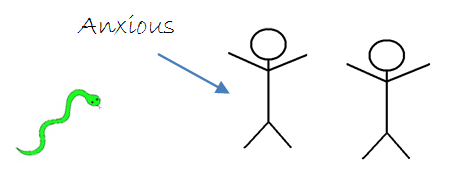
Then simply guess or imagine what the stick-person might have been telling himself in this situation to create his anxiety.
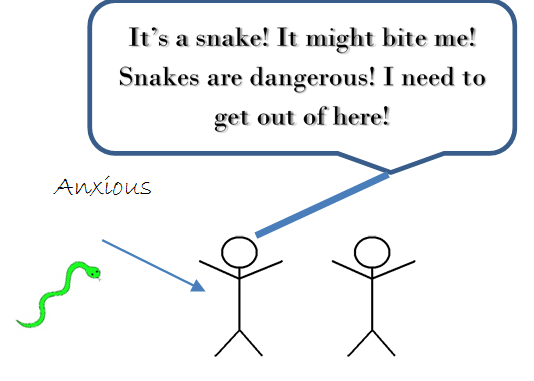
Usually, what we imagine the stick person might have been thinking is precisely what we were telling ourselves in this situation.
Meditation and free association
Other techniques to become more aware of our thinking include meditation and free association. These techniques encourage us to be mindful or our thoughts in the present moment.
Once we can identify our thoughts, we can then use cognitive-restructuring techniques to change the way we feel and/or behave.
 south island wellness