The Core of Therapy for Anxiety

Exposure Therapy and Behavioral Experiments

Cognitive Behavioral Therapy is the most validated form of therapy for anxiety disorders. In a huge review of studies exploring the effectiveness of CBT, the researchers found “The efficacy of CBT for anxiety disorders was consistently strong” (click here for a link to a free copy of this study). In another comprehensive review of studies exploring CBT for generalized anxiety, the authors concluded “when compared to waiting list control groups, these treatments have large effects on worrying, anxiety and depression, regardless of whether effects were measured with self-report measures or with clinician-rated instruments” (click here for a copy of this study). Many people would prefer their anxiety just went away but research suggests few people who do nothing, reduce their anxiety. As the studies above suggest, one of the things people can do to reduce their anxiety is cognitive-behavioral therapy and at the core of CBT for anxiety is exposure therapy and behavioral experiments.

Exposure therapy:

Simply put, exposure therapy involves exposing the client to their feared situations in a gradual, repeated, and prolonged manner until the client becomes desensitized. For example, if a client is terrified of public speaking they may work with their therapist to create a list of anxiety provoking situations (speaking in class, watching videos about public speaking, taking a class on public speaking, imagining speaking in public, speaking in a meeting at work, talking to a cashier at a store, doing a speech at Toastmasters, etc.). The client then ranks these situations from least anxiety provoking to most anxiety provoking, this is called an anxiety hierarchy. Then starting with a situation that does evoke some anxiety but is not overwhelming, the client would repeatedly expose themselves to these situations, over and over, until they become desensitized to this situation. A useful example of this most people can relate to is learning to swim as children. Many children are afraid or at least tentative about the water, but their parents encourage them to become more comfortable over time, often enrolling them in swim classes. As the child is gradually exposed to the water over time, they become less afraid. Alternatively, the children that are terrified of the water, and refuse to ever go in the water continue fear the water.

*For more information about exposure therapy see my article “Overcoming Anxiety and Avoidance” by clicking here, or download our free anxiety workbook by clicking here.

Behavioral experiments:

Behavioral experiments can take a number of different forms. Similar to exposure therapy, the client and therapist may work together to create a list of anxiety provoking situations. Then the client and therapist will work together to identify the client’s fears about what could go wrong in these situations. Often these fears are exaggerated and extreme but the client sees them as perfectly reasonable. So then we create a little experiment in which the client enters the feared situation and observes to see if their fears come true. Then the client runs the experiment several times in an attempt to gather more information. Once the client has run the experiment several times, they reconvene with the therapist to discuss what they have learned about their fears and their abilities to cope.

For example, perhaps one of the situations on the client’s anxiety hierarchy is saying “no” to other people. Perhaps the fear in this situation is something like “If I say no to my mother when she asks me to do something, she will call me selfish, the rest of my family will hate me, and I won’t be able to handle that.” So then the client and therapist run an experiment in which the client talks with their mother, explains they are trying to be more assertive and wants to work on saying “no” sometimes. Then the next time their mother asks them to give them a ride to the store, the client explains they cannot help that day due to other commitments, then observes what happens. In this situation, the client’s mother may very well call the client “selfish” and their family may complain, but the client also learns they can survive being called selfish and occasionally listening to complaints. Or perhaps the client’s mother understands the client has other commitments and they schedule a plan in which the client gives their mother a ride another time, or the client’s mother finds another way to the store. See the below table for an example how I would write-up a behavioral experiment assignment with a client.
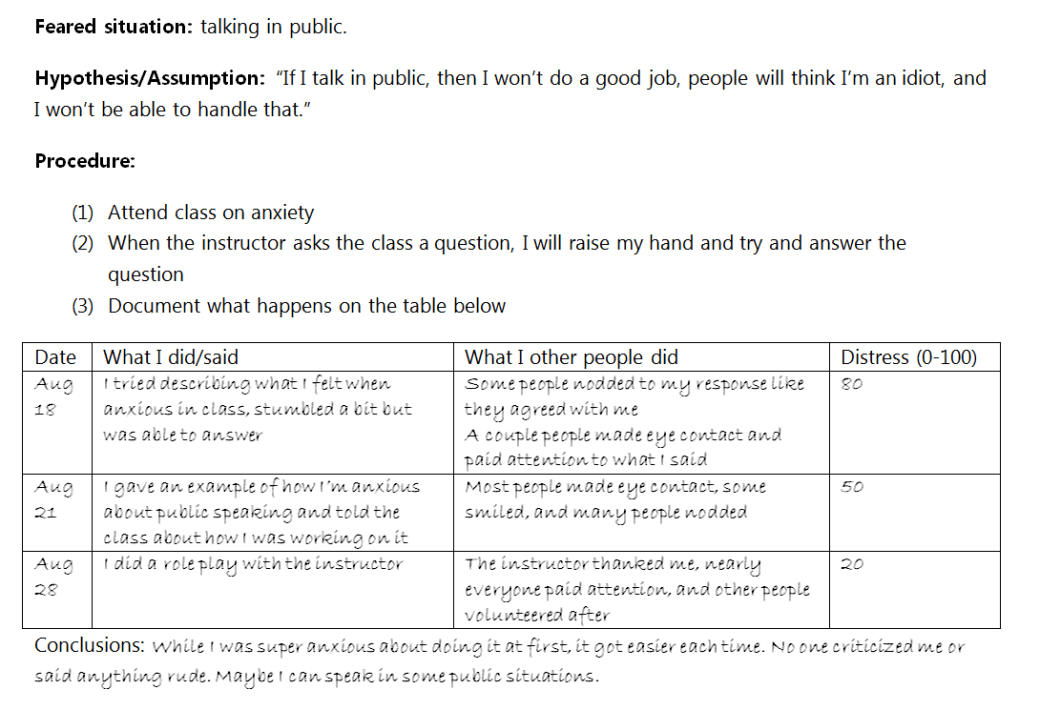
BE

Another type of behavioral experiment involves the client identifying what they suspect other people believe then conducting a survey to assess the accuracy of the client’s assumptions. For example, the client may believe that people believe that women over a particular weight are “unattractive.” Clients may start by simply ask some trusted friends or family about this assumption. They may take photos of themselves or others to friends or family and ask people about their impressions about the people in the photos. In this example, the client ideally learns that attractiveness is not directly related to something as arbitrary and simplistic as weight.

How it works:

In my experience, exposure therapy and behavioral experiments have been immensely helpful for clients. Clients usually report dramatic shifts in their anxiety in only a short period of time. In CBT we assume the client becomes less anxious in situations they are exposed to because they learn that their initial assumptions about the dangerousness of the situation is exaggerated and their beliefs about their abilities to cope with the danger posed by those situations is minimized. In other words, their cognitions change. After exposing themselves to a variety of different situations, the client learns they have a habit of exaggerating danger and minimizing their abilities to cope, and so they become less anxious in other situations they have not exposed themselves too.

For example if you are anxious about travelling but you muster the courage to go to Mexico, you might learn that Mexico isn’t as dangerous as you expected. Then if you go to Germany you might learn that Mexico and Germany are safe. Then if you go to India you might learn that Mexico, Germany, and India can be travelled to safely. Then you might learn that travelling in general can be done safely, not only to those countries you have been to in the past.

Challenges:

One challenge in using exposure and behavioral experiments is explaining the importance of actually facing fears to the client. Some clients have spent decades avoiding situations that make them anxious and the thought of deliberately exposing themselves to these situations is terrifying. People tend to want to avoid situations that make them anxious. Unfortunately, it is this very avoidance which perpetuates the anxiety indefinitely.

Another barrier to effective exposure and behavioral experiments is called “safety behaviors.” Safety behaviors can sometimes resemble the compulsions of someone who struggles with OCD. Safety behaviors are unnecessary, excessive, or unhelpful activities or strategies people use in anxiety provoking situations to protect them from “something going wrong.” When the client is anxious about going to a new restaurant they may excessively research the restaurant online to create a plan to prevent something “bad” from happening. In this example the excessive research is the safety behavior the client uses to keep themselves “safe.” Then when they go to the new restaurant and nothing “bad” happens they convince themselves it is because they researched prior to going. In this situation, the client has not learned that they can safely go to a variety of different restaurants, but instead they have learned they can go to a restaurant when they excessively research it in advance. Other examples include holding glasses very tightly when you’re afraid of spilling, distracting yourself with your phone when afraid of standing in lines, and never disagreeing with people when you are afraid of conflict. Research suggests it is imperative safety behaviors are identified so the client can either avoid using them or gradually reduce the use of safety behaviors over time.

Sometimes a client’s anxiety is about situations to which they cannot be exposed. For example, the client might be terrified of earth quakes, someone dying, their son being in a car accident, getting fired, or being homeless. When the client cannot be directly exposed to their feared situations, we have got to get creative. We can watch videos of these situations, we can do research, we can read stories, we can write then recite our own stories in which the client is exposed to these situations, etc. This is based on the idea that thinking about the feared situation can actually desensitize the client. Some of these interventions are called “imaginal exposure.”

Conclusions:

Research suggests CBT is an effective treatment for anxiety disorders. Exposure therapy and behavioral experiments are core elements of CBT for anxiety. By facing fears the client learns their feared situations are not as catastrophic as originally predicted and their ability to cope is better than expected.
 

When I met fear

Admittedly, it took me a long time to learn to listen to my fear. My earliest memory is from when I was three years old. My Mother, Father, little brother and I went to play in a local river. I did not recognize the danger and I fell into the water. I remember feeling helpless and confused and then my father saved me. Although I’m sure there were previous times, this was the first time I remember meeting fear.

As a man, I met fear on the top of a mountain with the whole universe watching. He greeted me as an old friend and embraced me with genuine warmth.

“What would my life be without you?” I asked.

“Why ask me that my son? Have I not protected you and guided you through all of the horrors in the dark?” he asked.

“I’ll admit there have been times when you have saved me from suffering and almost certain death, but I’ve noticed the times I have truly lived were the times I had the courage to ignore your warnings. When I have wanted to love, you warned me about humiliation and rejection. When I aspired to more, you took the air from my lungs and warned me about losing what I’ve got. And when I prepared to rest you made me uncomfortable and gave me fantasies about failure and suffering. But when I ignored you, I loved with my whole heart, I worked with passion, and I rested enjoying the present.” I explained.

Fear smiled with knowing sadness and replied “Even I am conflicted in this messy existence. I did indeed warn you of humiliation, rejection, loss, failure, and suffering. But, in those times of action and acceptance, I also spurred you forward with an even greater fear – a fear of dying without living.”

As a child I had to learn to listen to my fear. As an adult, I suspect I must learn when it should be ignored.

Perfectionism: Life-satisfaction and coping with challenges

People with anxiety and panic frequently tell themselves “I must do perfectly well” then ask themselves some version of “will I do perfectly well” and the answer is always “no.” After they have avoided the task, or tried and failed to meet their hopes, they then become depressed because they tell themselves they did not do as well as they “should” have done. These are some of the claims made by one of the most influential contributors to counselling psychology in history, Albert Ellis. (See here)

While, I’m not bold enough to claim that perfectionism is the core of mental illness, the majority of my clients report high levels of perfectionism. There does seem to be a real connection between anxiety, depression, and perfectionism. Therefore, this article delves into some modern research on perfectionism, how to know if you might practice unhelpful perfectionism, and what you can do if you are a perfectionist, to live a more satisfied life.

Perfectionism

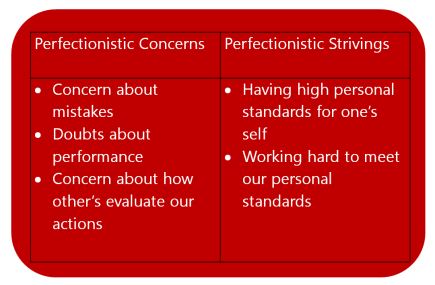
According to research, there are two dimensions to perfectionism: perfectionistic concerns and perfectionistic strivings.

concerns-vs-striving

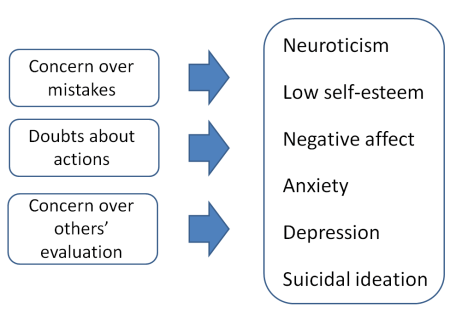
While these two dimensions are related, they are not the same thing and you can have one without high levels of the other. In other words, you can have high personal standards and work to meet those standards, without over-focusing on mistakes, excessively doubting your performance, or being very concerned about what other people may think. Research shows people who report high levels of perfectionistic concerns also typically report lower life satisfaction, neuroticism, low self-esteem, negative affect, anxiety, depression, and suicidal ideation. While people who report high levels of perfectionistic strivings, without high levels of perfectionistic concerns, report higher levels of conscientiousness, positive affect (they are generally happier), endurance, and academic performance (Stoeber & Otto, 2006).

1

When working with clients, I often hear rationalizations like “my perfectionism motivates me to work harder” or “I have to be a perfectionist or something really bad might happen.” The research described above does suggest that there are a number of benefits to having high personal standards and working hard to achieve those standards. However, when we are overly focused on making mistakes, doubting our actions, and focusing on what others think, we lose the positive benefits of our perfectionism. For the remainder of this article, I’ll refer to being overly concerned about mistakes, doubting ourselves, and being focused on how others might evaluate our performance (perfectionistic concerns) as “unhelpful perfectionism.”

Interestingly, unhelpful perfectionism is a recipe for low life satisfaction regardless of how well we actually do. In a study from Pennsylvania State University, 273 students reported engaging in unhelpful perfectionism led to less satisfaction with grades, regardless of how well they did (Grzegorek, Slaney, Franze, & Rice, 2004). In other words, even if they met their high personal standards, they were still unsatisfied if they were overly focused on making concerns, doubting their actions, and focusing on what others think.

How to know if you might practice unhelpful perfectionism

People that practice unhelpful perfectionism might claim:

  • If I fail at work/school, I am a failure as a person
  • I should be upset if I make a mistake
  • I hate being less than the best at things
  • If I do not do as well as other people, it means I am an inferior human being
  • Even when I do something very carefully, I often feel that it is not quite right
  • I usually have doubts about the simple everyday things I do
  • I tend to get behind in my work because I repeat things over and over
  • I find it difficult to meet others’ expectations of me
  • The better I do, the better I’m expected to do
  • Anything I do that is less than excellent will be seen as poor work by those around me
  • My family expects me to be perfect

These are items from two measures of perfectionism, the Frost Multidimensional Perfectionism Scale (Frost et al., 1990) and the Multidimensional Perfectionism Scale (Hewitt & Flett, 2004) and they reflect concern about mistakes, doubts about actions, and concern about other people’s evaluations. Beliefs and behaviors like these tend to interfere with a person being satisfied in life.

 Increasing satisfaction as a perfectionist

In 2011, two researchers from the University of Kent, Joachim Stober and Dirk P. Janssen, wanted to better understand the relationship between perfectionism, how people typically coped with stresses in their lives, and the amount of satisfaction they generally felt at the end of the day. They found people reporting high levels of unhelpful perfectionism seemed to cope with stressors in their lives in similar ways, and these coping mechanisms were contributing to lower satisfaction. People who reported a lot of unhelpful perfectionism reported typically trying to cope with stresses by criticizing themselves or blaming themselves for the “bad things” that happen to them. Unsurprisingly, self-criticism was associated with diminished satisfaction.

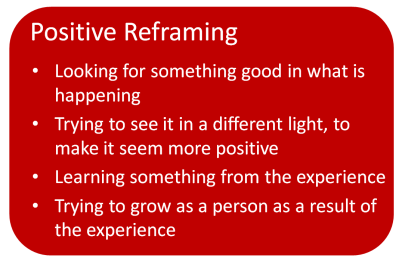
Alternatively, people who reported high levels of unhelpful perfectionism reported more satisfaction when they used a coping mechanism “positive reframing” (aka “positive reinterpretation”). These people attempted to cope with challenges by “trying to see it in a different light, to make it seem more positive” or “looking for something good in what is happening” (Carver, 1997).

positive-reframing

Two other ways of trying to cope with perceived failures were related to high levels of satisfaction, acceptance (“accepting the reality of the fact that it has happened”) and humor (“making fun of the situation”). Although, these coping mechanisms seemed to be less effective for people reporting high levels of unhelpful perfectionism.

Positive reframing has been explored in great detail in a multitude of studies over the last 30 years. Back in 1984 Lazarus and Folkam explained that positive reframing allowed people to manage their distress when challenged so they could continue with effective problem solving. This combination of positive reframing and actively trying to deal with stressors in an effective way can be an incredibly useful way to handle challenging situations in life.

Summary

We can have high personal standards and work hard to achieve these standards without over-focusing on our mistakes, excessively doubting your performance, or being very concerned about what other people may think. Indeed having high personal standards is associated with better life satisfaction. However, when we engage in unhelpful perfectionism it leads to reduced life satisfaction, neuroticism, low self-esteem, negative affect, anxiety, depression, and suicidal ideation.

Examples of unhelpful perfectionism include claiming things like:

  • If I fail at work/school, I am a failure as a person
  • Even when I do something very carefully, I often feel that it is not quite right
  • Anything I do that is less than excellent will be seen as poor work by those around me

However, even if we engage in unhelpful perfectionism we can experience greater satisfaction in life, by attempting to cope with challenges by seeing challenges as opportunities, focusing on what we learned from challenging experiences, and looking for something good in what has happened. By thinking about problems in this proactive way, we are better able to engage in effective problem solving.

Overcoming Anxiety and Avoidance

Although this will likely reduce the number of “likes” I get for this post, I believe it is important to begin with some honesty. Overcoming anxiety is hard work. Most people want a simple and easy answer that can make all of their suffering go away. However, for every complicated and messy problem there are many simple and easy answers that are ineffective. For example, in Canada the use of antidepressants increased over 450% between 1981 and 2000, but the demand for mental health services has never been higher. This post is not an “8 easy steps to being less anxious” kind of post, it is more of a “if you work really hard, stay determined despite set-backs, and keep an open-mind about trying new things you may be able to make some real improvements to your life” kind of post.

Anxiety and Avoidance

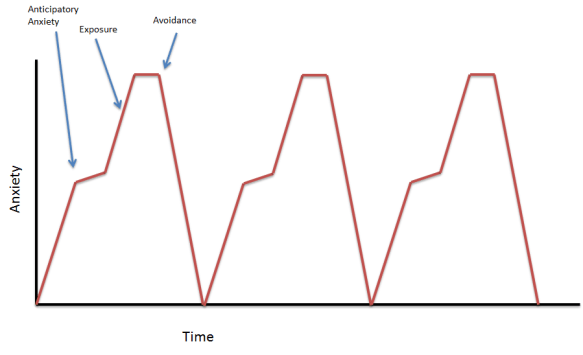
Anxiety is a normal reaction to perceived threats. However, when we have a tendency to focus on threatening situations, the problems in our lives, we are fueling excessive amount of anxiety. One way we attempt to reduce the amount of anxiety we experience is by avoiding challenging situations. However, avoidance prevents us from overcoming our fears. Furthermore, as we avoid more and more things, our lives become more and more restricted.

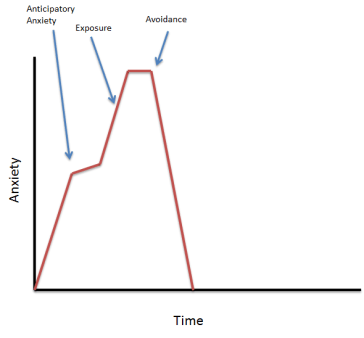
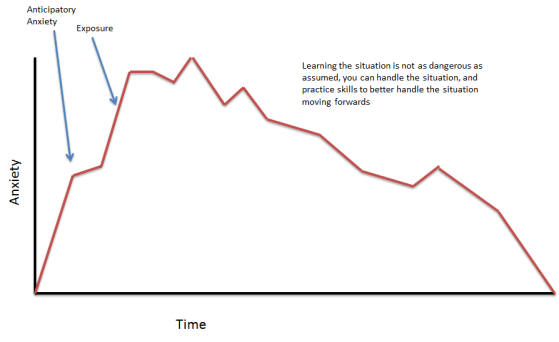
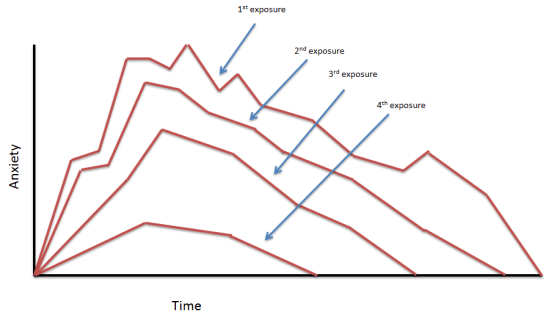
For example, if you had social anxiety and were terrified of 1talking to authority figures, you would likely experience anticipatory anxiety before you spoke to people of authority, then when you did have to talk to someone of authority (exposing yourself to the feared situation) your anxiety would likely spike. Then when you avoid the situation by promptly leaving, your anxiety will naturally go down. Unfortunately, when we cope with anxiety by avoiding challenging situations we cannot challenge our assumptions that the situation is dangerous, we cannot challenge our assumptions that we cannot handle the stressful situation, nor can we learn how to handle the situation more effectively. So then the next time we exposure ourselves to the stressful situation we experience a similar amount of anxiety.
2

Overcoming anxiety can be accomplished a number of ways. However, research strongly suggests that one of the most effective strategies for overcoming anxiety is something called “exposure therapy.” Exposure therapy rests on the premise that if we can expose ourselves to our anxiety provoking situations in a certain way, we can learn: the situation isn’t as dangerous as we assume, we can handle the challenging situation, and we can practice skills to better handle similar situations in the future.

3

Exposure therapy

  • Begin by creating a list of situations you avoid
  • Rate how much anxiety you suspect you will experience in each of these situations on a scale from 0-100
  • Select a situation that will provoke a small amount of anxiety – set yourself up for success
  • Create a plan to expose yourself to this situation –when? Where?
  • Expose yourself to the situation
  • When you are in the situation try and pay attention to what is going on around you as opposed to what is happening in your body or distracting yourself (looking at your phone, talking to a friend, reading a book, etc.)
  • Stay in the situation until your anxiety has diminished, do not just leave when you feel some anxiety
  • After your anxiety has gone down, ask yourself what you have learned about how dangerous the situation was, what you have learned about your ability to cope (did you survive?), and some skills you could practice to handle the situation more competently in the future
  • If you notice yourself going over and over the situation in your mind, distract yourself by doing something engaging
  • When you are able, expose yourself to the same situation again and again until you do not feel very much anxiety at all in that situation
  • Once you have completed the first anxiety provoking situation, move on to another situation on your list of anxiety provoking situations and repeat this process

By exposing ourselves to anxiety provoking situations appropriately, we are able to reduce the amount of anxiety experienced when we face similar situations in the future.

4

Some notes about exposure therapy:

Exposure therapy can be immensely effective for anxiety created by many different situations. Personally, I have seen clients make radical changes in only a small number of sessions when they are committed to their exposure plan. However, it is important to remember than some situations are actually dangerous and we are not always exaggerating the danger in our minds. Therefore, I do not encourage people to behave recklessly, for example standing in a busy highway, going down dark alleys at night, or committing any crimes. Also, this article only describes one type of exposure therapy, something called “in vivo” exposure therapy and this type of exposure therapy cannot be used to overcome some anxiety provoking situations. Obviously, we cannot expose ourselves to our fear of our own death (at least not more than once), to fears of loved ones dying, or to fears of natural disasters. For these types of hypothetical fears, we may need to practice something called “imaginal exposure” which is not described in this article.

Some notes for therapists:

Many clients struggle with creating the motivation to engage with exposure therapy. When we are distressed we often resort to coping mechanisms that are familiar to us, even if they are not helpful. It can be useful to go slow with clients and discuss the costs and benefits of avoidance. Encourage the client to consider what their life may be like if they continue to avoid anxiety provoking situations indefinitely and/or consider the opportunities their avoidance may have already cost them. Remember, it is not our job to convince the client to do anything. Instead we are there to help them make informed decisions. If the client chooses to continue to avoid, while knowing the consequences of this decision, that is their choice and that should be respected.

Processing what the client has learned from exposing themselves is just as important as collaborating with the client to design the exposure activity. “what did you learn from exposing yourself to this situation?”, “what did you learn about your ability to cope with the situation?”, “what did you learn about your anxiety in general?” “what did you learn about your fears?” – Questions like these can be very helpful.

Improve your Relationships by Understanding and Managing Anger

You never listen to me. I fell like you are overreacting. I can’t do anything right, I’m always the bad guy. Don’t get upset. You always do this. You’re an asshole. Why do you have to be such a bitch? This is why this shit always happens to you.

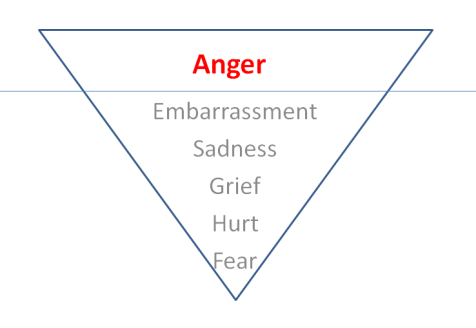
Have you ever been hanging out with friends and have the displeasure of watching another couple’s argument turn into a full-blown fight? Have you ever been shocked by the devastatingly hurtful things family members say to each other? I’ve both been the shocked observer and I reluctantly admit to having been one of the people saying the hurtful things. On the surface, these statements appear to be motivated by anger. However, anger is described as a “surface emotion” and underneath anger there is usually a more vulnerable emotion like hurt, sadness, embarrassment, grief, etc.

anger

Our angry behavior (yelling, intimidating, saying hurtful things) can be a way of communicating more vulnerable emotions. Unfortunately, communicating in this way is inherently manipulative because we are not communicating directly about what is going on for us. Instead of using the words “when you said I was lazy, I felt hurt because I really value your opinion. I also felt afraid because I was concerned you might not want to be in a relationship with someone you think is lazy”, we hope they get some form of this message through our angry behavior.

Our anger can also serve as a tool to teach another person about what we want. People learn through processes like reinforcement, punishment, and extinction. When another person does something we don’t like, we can use anger to punish them, in hopes they will not replicate this behavior in the future. For example, when Person A says something hurtful (you’re lazy), Person B may retaliate to punish the other person to reduce the probability of future hurtful comments. However, when we are in a relationship with a person and they are continuously punishing us we are likely going to develop resentment because, by definition, people don’t like being punished. So while anger can be a powerful form of punishment, it can seriously poison a relationship.

Holding on to anger is like grasping a hot coal with the intent of throwing it at someone else; you are the one who gets burned. – Buddha

One of the best examples of these two concepts is when we get angry about another person getting angry. Getting angry at another person for getting angry at you is like trying to put out a camp fire with gasoline. Person A gets mad, then Person B thinks something like “I don’t deserve to be treated like this!” and gets angry to punish Person A. In addition to feeling anger, Person B is also probably feeling fear, hurt, and maybe even embarrassment.

If you have the goal of intimidating someone, expressing anger in an aggressive way may move you closer to achieving your goal. However, if you have the goal of having a good relationship with the other person, expressing anger in an aggressive way will be less helpful.

So how do we reduce the likelihood we will get extremely angry and how do we communicate better when we are angry?

Reducing the likelihood of getting extremely angry. CBT recommends we begin by identifying our “triggers” and times when we are more likely to become triggered. “Triggers” are things (people, comments, situations, etc.) that rapidly increase our emotional responses. For example, if you are triggered by criticism, you are likely to have an extreme emotional response to being criticized. Common triggers include perceived rejection, failure, abandonment, and loss. Identifying your triggers in advance is a form of exposing yourself to your triggers through the use of your imagination. This “imaginal exposure” actually can reduce how distressing these triggers will be when you are exposed to them in real life. Furthermore, identifying your triggers in advance allows you to plan how you want to respond when faced with this trigger.

We are more likely to be triggered in certain circumstances. For example, I am more likely to be triggered when I am tired, hungry, or while drinking alcohol. So I make reasonable attempts to avoid situations that may trigger me during times when I’m more likely to become triggered. For example, if I have to talk to a friend about a sensitive topic, I do so when I’m rested, fed, and sober.

These two principles of identifying triggers in advance and considering times when we are more likely to become triggered can be useful for managing all extreme emotions, not simply anger.

Regardless of whether or not we identify triggers and times we are more likely to be triggered, we may still get triggered unexpectantly. While there are a ton of relaxation skills out there, some are more effective than others. These are the ones I recommend to people managing intense anger.

Minimize risk. Stop yourself from the “knee-jerk” reaction that often accompanies anger. Then I recommend you remove yourself from the situation if it is reasonably possible, it may also be useful to say something like “I don’t mean to be rude but I have to go calm down for a moment” and go for a walk.

Relax the body. Then cool off by splashing cold water on your face, taking a cold cloth and putting it on your face or the back of your neck, or taking a cold shower. You’ll learn that it is really difficult to stay mad when your face is frozen. Take some breaths, one useful breathing exercise is the 4-7-8 breath where you breath in for 4 seconds, hold your breath for 7 seconds, and breath out slowly for 8 seconds.  Intense exercise and something called “progressive muscle relaxation” also can be very effective for calming our bodies.

According to Baranowsky, Gentry, and Schultz (2011, p. 127), when our fight/flight/freeze response is activated we are using our “sympathetic nervous system” and when we are calm we are using our “parasympathetic nervous system.” When the sympathetic nervous system parts of our brain are dominant our thinking is reactive, we have an increased threat perception, and we have diminished brain functioning. By contrast when the parasympathetic nervous system parts of our brain are dominant, we are more capable of creative problem solving, we have better decision making, and we are better at regulating our emotions. By relaxing our bodies we can shift from sympathetic nervous system dominance to parasympathetic dominance.

Calm down the mind. Once our bodies are calm, we are more capable of communicating and problem-solving. We can use cognitive-restructuring strategies to identify the thoughts causing our intense emotional reactions, challenge the validity of these thoughts, and replace them with more realistic thoughts. The automatic thoughts commonly associated with intense anger include thoughts about fairness (How dare you call me a jerk after all I do for you! I don’t deserve this!) and about how we want people to behave (You shouldn’t be acting like this! I should better at this! You should take out the trash!).

We can also use mindfulness skills to calm our mind. Put simply, when using mindfulness we are paying attention to what is going on in our mind, without judgement. We notice, accept, and let go of our anger inducing thoughts. It sounds simple but it takes practice.

Communicate. Once our bodies and our minds are calmer we may choose to communicate. Some good skills for communicating assertively include “I-messages” and the “assertive message format.”

I-messages typically include a description of how we feel, explaining the reasons for this emotional response, and clearly describing what you want. Some examples:

I felt angry when you said that I never listen to you, I’d like to talk about this.

I felt concerned when you raised your voice earlier, I’d appreciate if you could avoid doing that in the future.

I felt sad and surprised when you said my family is crazy, I’d like to understand where that comment came from.

 The assertive message format includes: a description of behavior, an interpretation, describing your emotions, consequences, and your intention/position. These components can be combined in any order.

You were running behind yesterday and (behavioral description), as a result we were late to meet up with everyone (Consequence), I’m sure you didn’t mean to be late but (interpretation), and honestly, I was feeling a little annoyed and frustrated (feelings), next time, I would appreciate it if you could toss me a text if you’re running behind (intention/position).

“We can say what we need to say. We can gently, but assertively, speak our mind. We do not need to be judgmental, tactless, blaming or cruel when we speak our truths”

― Melody Beattie

Both I-messages and the assertive message format are designed to open a dialogue with the other person, while reducing the probability they will respond defensively. When using these skills it is important to avoid blaming (you are responsible for your own emotional reactions), generalizing (“You’re always late”), or name calling. I’ll revisit more communication skills in future posts.

To summarize, anger is a surface emotion, usually with more vulnerable emotions underneath. Anger can be used to communicate more vulnerable emotions as well as punish other people to behave in ways that we want. We can reduce the likelihood of becoming extremely angry by identifying our triggers and times when we are more likely to become triggered. When we do become angry, we can manage our anger by reducing the risk, calming our bodies, calming our minds, and communicating effectively in a respectful and compassionate way.

Improve your approach to dealing with problems in life (Part 1)

The Jewish psychiatrist Viktor Frankl remembers the day he entered the camps:

Then the train shunted, obviously nearing a main station. Suddenly a cry broke from the ranks of anxious passengers, “there is a sign, Auschwitz!” Everyone’s heart missed a beat at that moment. Auschwitz – the very name stood for all that was horrible: gas chambers, crematoriums, massacres. Slowly, almost hesitatingly, the train moved on as if it wanted to spare its passengers the dreadful realization as long as possible: Aushwitz!

His book Man’s Search for Meaning tells a harrowing tale of some of the worst conditions humans have been exposed to in modern history. As I read this book for the first time, several years ago, I was mesmerized by Dr. Frankl’s seemingly endless ability to recognize the opportunities within his experiences. His beliefs about problems and suffering were infectious.

Negative Problem Orientation

Put simply, a person’s problem orientation refers to their beliefs about problems and their ability to solve problems. People with a negative problem orientation are more likely to view problems as excessively threatening, they typically doubt their ability to solve problems, and they believe negative outcomes will occur regardless of how much effort they put in to solve them. As a result of these beliefs, researchers Dugas and Robichaud suggest people with a particularly negative problem orientation are more likely to be frustrated, irritated, anxious, or depressed when they face a problem. Behaviorally, people with a negative problem orientation are more likely to procrastinate and/or avoid problem solving. As a result, they can make new problems for themselves and increase worries.

Perhaps unsurprisingly, negative problem orientation has been connected with a wide variety of mental health difficulties including generalized anxiety disorder, depression, pathological gambling, and post-traumatic stress disorder (Robichaud & Dugas, 2005).

Locus of Control

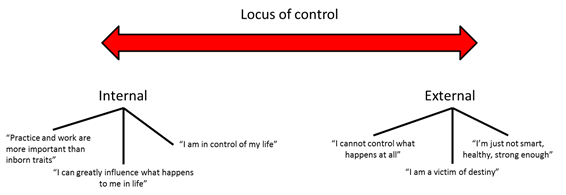
In my opinion, a person’s problem orientation plays a massive role in how they approach the world. There seems to be a large overlap between problem orientation and something, in psychology, we call “locus of control.”  Our locus of control can be described as our beliefs about how much we influence what happens in our lives. People with an “internal locus of control” typically believe they greatly influence their destiny. While people with an “external locus of control” typically believe that what happens in their lives is largely controlled by forces outside of them. Research over the last 65 years has suggested that people with an internal locus of control have greater academic success, are more motivated, are more socially mature, have less stress and depression, and live longer. They “earn more money, have more friends, stay married longer, and report greater professional success and satisfaction” (Duhigg, 2016, p. 24). So to summarize, people with an internal locus of control will usually be less threatened by problems, work harder to solve problems, and believe they can mitigate negative outcomes through effective problem solving. In other words, they have a more positive problem orientation.

locus of control

So if a negative problem orientation and an external locus of control are typically unhelpful for promoting health and wellbeing, what can we do to change?

Luckily, research suggests there are a few things we can do to improve our problem orientation and our beliefs about locus of control. Dugas and Robichaud suggest we first have to learn how to identify problems. Many clients enter therapy and believe that their emotions are the problem, they just want to be happy. However, emotions are not the problem. Emotions are data, they are just information giving you clues something is or is not working for you in life. The problem is not that you are depressed, the problem may be you are stuck in a relationship that is not good for you, it could be that your habits are not particularly healthy, it might be that you are stuck in depressive thinking habits, perhaps the problem is that you are in a concentration camp, etc. Once we can see our emotions as information, this can help you identify appropriate solutions to the real problems.

The belief that we are exceptional because we experience problems can keep us stuck. Why does this keep happening to me? Why was I the one who was dealt a bad hand in life? We can improve our problem orientations by challenging these kinds of beliefs and recognizing that experiencing problems in life is normal. Suffering is an important part of life, it is times when we suffer the most that we are motivated to adapt and grow the most.

Challenge filtering and overgeneralizing (see our cognitive distortions list). An internal locus of control and/or a negative problem orientation occurs because we are not paying enough attention to all the times your effort and practice have influenced outcomes. We conclude because we could not have possibly prevented ____________ from happening in the past, why bother trying in the future? While there is a lot in life that you cannot control, there is a massive amount that you can. By just focusing on the things we cannot control, we are underestimating the number of choices we have. When we underestimate the choices we have, we are reinforcing the belief that we are not responsible for what happens to us and this can be a very comfortable delusion to live in. However, this short term comfort comes with a price, it disempowers us and maintains a victim mentality.

Lastly, and perhaps most importantly, we can improve our problem orientation by recognizing the opportunities that are within all of the problems we experience. Every problem has opportunities associated with it. Few people illustrate this better than Viktor Frankl. While in the camps, he became very sick, and with the sickness came a far greater likelihood of being “selected” to go to the gas chambers. Despite his sickness he remembers:

We were sick and I did not have to go on parade. We could lie all day in our little corner in the hut and doze and wait for the daily distribution of bread (which, of course was reduced for the sick) and for a daily helping of soup (watered down and also decreased in quantity). But how content we were; happy in spite of everything.”

This sickness gave him the opportunity to rest. More generally, by being a prisoner within the camp, Frankl recognized he was given the opportunity to study what happens to a human under such circumstances. He was given the opportunity to understand how people find meaning and purpose even in the worst of conditions. Gordon Allport describes Frankl’s conclusions beautifully in his preface:

In the concentration camp every circumstance conspires to make the prisoner lose his hold. All the familiar goals in life are snatched away. What alone remains is “the last of human freedoms” – the ability to “choose one’s attitude in a given set of circumstances.”

Being in the camp presented many, very real and horrifying, problems. However, Frankl was also given the opportunity to choose how he was going to cope with these problems. He was given the opportunity to search for answers to some very fundamental human questions – what prevents some men from committing suicide in such horrible conditions? Why choose to live when one can simple run to the electric fences at any time? What motivates a man to treat prisoners a particular way? Etc.

When your partner says something you don’t agree with, you are being given the opportunity to practice your non-defensive communication skills. When you lose a relationship you have the opportunity to be a kind, loving, and respectful person even when things do not go your way. When you get lost, you have the opportunity to become familiar with somewhere new. When you are in a concentration camp, you have the opportunity to study how humans adapt to such horrible conditions and find meaning and purpose despite great suffering.

If you have children, it is likely they will experience their own challenges in life (divorce, trauma, accidents, health problems, etc.) and every time you experience these things, you are being given the opportunity to teach your kids how to effectively face these problems in their own lives. By recognizing the opportunities within the problems we face, we are going to be more likely to accept when problems occur and we will be more motivated to engage with our problems in a helpful way.

Duhigg, C. (2016). Smarter, faster, better: The secrets of being productive in life and business. Doubleday Canada.

Frankl, V. E. (1959). Man’s search for meaning: An introduction to logotherapy. Washington Square Press, New York.

Robichaud, M., Dugas, M. (2005). Negative problem orientation (part I): Psychometric properties of a new measure. Behavior Research and Therapy (43)3, 391-401.