Identifying Automatic thoughts

Lots of people struggle with identifying their thinking. Some insist that they are “just anxious” and they have no worries creating this anxiety. While it may be the case that some health conditions can produce an anxiety like response, CBT suggests that the vast majority of the time there are thoughts or beliefs creating our emotions and there are some tools we can use to help identify them.

The “what am I feeling” technique

This is a fundamental technique in CBT. Our feelings are excellent clues into what we are thinking. Also, since we frequently misuse the word “feel” in English, sometimes our “feelings” are actually thoughts in disguise. For example, woman struggling with guilt about parenting insisted she couldn’t identify her thoughts when she felt guilty. When describing the situation in therapy she claimed “I just feel like a bad Mom.” This was immensely helpful because she had been confusing her feelings with her thoughts. She felt guilty and she thought “I’m a bad mom.”

Even when we are not confusing thoughts and feelings, our emotions give us hints about our thinking. As described above, when we are anxious we are usually worried about something, when we are depressed we are usually thinking negative thoughts about ourselves, the world, or our futures, and when we are angry we are usually thinking about what “should” happen or how someone “should” behave. Sadness tends to be about loss, guilt about judgments about our own behavior, and embarrassment tends to be created by assumptions about how others might judge us.

You can improve your skills of identifying your thoughts by checking-in with yourself next time you have a feeling. So next time you feel anxious ask yourself “what am I worrying about?”

The pen and paper technique

The first technique is very simple, but usually can be effective for most people. This technique involves carrying a small notebook, a piece of paper, or a cue card with you (and a pen) and writing down any automatic thoughts you have when you feel anxious, depressed, angry, etc. You can also use worksheets to help with this process. Here are some hints for writing down automatic thoughts:

  • Write your thoughts in short sentences like “I’m going to be late!” or “this person should learn to drive.” Do not write single word bullet points like “bad” or “guilty.”
  • Do not write your thoughts in the form of a question try and turn them into statements. For example, turn “Why am I such an idiot?” into “I’m such an idiot.”

The stick person technique

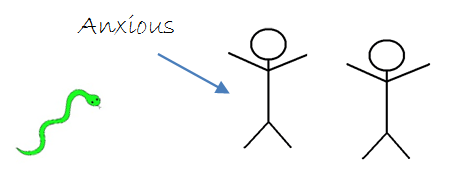
Although this one can seem silly, it can be one of the most effective skills for identifying thinking. Simple think of a time when you were feeling depressed, anxious, angry, etc. Then draw a stick person in that situation. Here’s an example of a stick-person getting anxious when they saw a snake when he was on a hike with his stick-girlfriend:

Untitled

Then simply guess or imagine what the stick-person might have been telling himself in this situation to create his anxiety.

Untitled2

Usually, what we imagine the stick person might have been thinking is precisely what we were telling ourselves in this situation.

Meditation and free association

Other techniques to become more aware of our thinking include meditation and free association. These techniques encourage us to be mindful or our thoughts in the present moment.

Once we can identify our thoughts, we can then use cognitive-restructuring techniques to change the way we feel and/or behave.

Understanding the Origins of those Negative Predictions and Judgments

tversky and kahneman


Amos Tversky (left) and Daniel Kahnement (right)


Daniel Kahneman won the Nobel Prize in 2002 for the work he, and fellow psychologist Amos Tversky, began in 1974 when they and published their article “Judgment under Uncertainty: Heuristics and Biases” in the esteemed academic journal Science (Vol 185. Pp. 1124-1131). Tversky and Kahneman sought to understand how humans made decisions in uncertain situations. This work suggests people use a series of mental processes to make decisions and the underlying machinery of these mental processes tends to make predictable errors. Their findings have profound implications for our understanding of mental health.

Anxiety 101 – a Review

Anxiety is the product of perceiving a threat to something we value. In the simplest terms, when we believe there is a bear (a threat) in the bush near us (something we value) our body gets ready to run/fight/or freeze (anxiety). This simple formula can take far more advanced forms because we can value other things besides our own physical health and threats can take many forms beside that of a bear. While threats and things we value can take many forms, our bodies only have a small number of responses. These responses are run, fight, or freeze and we interpret our bodies getting ready to do these things as anxiety. For example, public speaking is perceived to be a threat to our goal of being perceived as competent and confident, taking a test poses a threat to our hopes of completing a class with a particular grade, and running out of gas threatens our goal of getting where we want on time. Our bodies will get ready to deal with all of these threats in the same ways – by making us anxious.

An Available Heuristic

If we accept this formula as an explanation for why we get anxious, this leads to another reasonable question: How do we decide how much of a threat something is? Tversky and Kahneman provide us with an answer but first let’s consider some other questions:

  • When considering all of the words in the English language, which are three or more letters, are there more words with the letter K as the first letter, or more words with the letter K as the third letter?
  • What percentage of middle aged men will have a heart attack?
  • How honest are you?

To answer these questions our minds could use a number of different strategies. Our minds could list every known English word that is 3 or more letters, then compare how many begin with K and how many have K as the third letter. Even if we used this exhaustive and thorough strategy, our answers would be imperfect because we do not know every English word so we would be guessing based on the words we do know. As for the questions about heart attacks and honesty, we would never truly know the exact values because we are not omniscient and honesty is not something you can quantifiably measure. However, most people do not find it difficult to come up with answers to all of these questions. In fact, people tend to come up with answers extremely quickly.

When we are asked questions like these, our minds take the question we have been asked then quickly replace this very difficult question with a simpler question like “How easily can I remember or imagine something like this?”

If you are like most people, when asked the question about the letter K, you tried to think of words that begin with the letter K or had K as the third letter. If you could easily recall words beginning with K, but had greater difficulty thinking of words with K as the third letter, you concluded there must be more words beginning with K. Words with K tend to be easier to recall and most people assume there are more words beginning with K, even though there are more words with K as the third letter in English. Instead of being able to provide the true likelihood of heart attacks, our mind replaces this question with something like “How easily can you remember or imagine a middle aged man having a heart attack?” Then finally, you likely replaced the question about honesty with “How easily can I remember situations in which I was honest and dishonest?” It is not about how many memories we have being honest or dishonest, we form our judgments on the availability of those memories. Memories we can easily recall are said to be more available to our conscious minds than memories that are difficult to recall.

This mental “trick” is called the “availability heuristic.” As Tversky and Kahneman explain in their 1974 article, “There are situations in which people assess the frequency of a class or the probability of an event by the ease with which instances or occurrences can be brought to mind” (p. 1127). In other words, we believe something to be more likely if memories or fantasies of similar situations are “available” to our conscious mind. Most of the time the availability heuristic serves us pretty well. If something frequently happens in our life (the sun comes up every morning), one can assume it is likely for it to happen again without many costs being associated with this prediction. This allows us to avoid living in a constant state of uncertainty, predict what is likely to happen in the future, and plan accordingly. Unfortunately, the availability heuristic can be biased and sometimes this can have serious adverse consequences.

The availability heuristic is disproportionately influenced by recent and emotionally salient situations. Following a traumatic experience, people are far more likely to overestimate the probability of a similar traumatic event happening which artificially inflates our perceptions of how threatening a situation is, which in-turn unnecessarily increases anxiety and distress. Following a car accident, you will likely overestimate the likelihood of being in another car accident, which increases anxiety while driving. Following 9/11, many of us felt a new anxiety we did not previously experience while getting on air planes, not because flying was anymore dangerous (flying had probably never been safer than after 9/11) but because memories and fantasies of planes being high jacked were far more available.

Mental Process Underlying Mental Health Challenges

We determine which situations are threatening not by assessing the true threat level, but by assessing how easily we can remember or imagine similar situations ending-up poorly. Panic disorder can manifest in a number of ways, everyone is different, but people with panic disorder tend to worry that bodily sensations (heart arrhythmias, increased heart rates, accelerated breathing, dizziness, sweating, etc.) are evidence of a serious catastrophe (heart attack, stoke, going insane, etc.) which escalates anxiety resulting in panic attacks. Once we’ve had a single panic attack, the memory of this experience can be particularly available because panic attacks are so emotionally distressing. If we have had a panic attack in a store, we might later wonder about the possibility of having a panic attack in another store like Walmart. This question about the probability of having a panic attack in that particular Walmart at that particular time is replaced with “How easily can I imagine having a heart attack in Walmart?” If the answer is “very easily” then, we will assume the likelihood of having a panic attack in Walmart is high and we will likely avoid Walmart to avoid having another panic attack.

In obsessive-compulsive disorder (speaking of true OCD not the “OCD” people claim to have when they have strong preferences for cleanliness or organization), people can grossly overestimate the likelihood of someone breaking into their home and murdering their family because this specific fantasy can be incredibly distressing. When a fantasy is emotionally distressing, it is more available to consciousness, and this availability inflates perceptions of likelihood. Put simply, because the obsession is so upsetting, people will think it is likely, and they will act compulsively to reduce the probability of the feared event occurring.

In addition to anxiety disorders, the availability heuristic also plays a role in the development and maintenance of other mental health challenges. People with eating disorders often worry that people will judge them negatively if they were “fat.” They sometimes have vivid fantasies of being publically ridiculed or rejected for having what most people would consider to be an average or even below average weight. The maintenance of an eating disorder is riddled with availability heuristic errors. Often people will be able to easily imagine people judging them for being “fat” because they themselves frequently judge other people as fat and they take this as evidence suggesting other people have similar thoughts. The memory of their own judgments will be available because they are so frequent and this will inflate their perception about the likelihood of other people being judgmental like themselves. There are often historical traumas in childhood in which the person with the eating disorder was indeed bullied, mocked, and/or criticized, sometimes by close loved ones. While memories of this abuse are no longer recent, they may be incredibly available because of their emotional salience. They may also judge themselves as inadequate because they can easily recall examples of “beautiful” celebrities which inflates their perception of the regularity of these “beautiful” people.

When we are depressed, we will often have negative automatic thoughts about ourselves like “I’m a failure” or “I’m a loser.” Our minds will form these judgments by seeing which memories are most available, so if we can easily recall examples of “failures” or “losing”, we will be more likely to make judgments consistent with these memories. Since we tend to feel negative emotions more intensely than positive emotions, memories involving failure and loss may be easier to recall, and so these memories bias the availability heuristic and negatively distort our judgments.

Help is Available

The availability heuristic seems to be at the heart of many mental health challenges and this has some interesting implications for the treatment of mental illness. The availability heuristic is biased by recent and emotionally evoking memories and being aware of these biases allows us to think critically about the assumptions we make. In his 2011 book “Thinking, Fast and Slow” Daniel Kahneman explains “Resisting this large collection of potential availability biases is possible, but tiresome. You must make the effort to reconsider your impressions and intuitions by asking such questions as, ‘Is our belief that thefts by teenagers are a major problem due to a few recent instances in our neighborhood?’ or ‘could it be that I feel no need to get a flu shot because none of my acquaintances got the flu last year?’ Maintaining one’s vigilance against biases is a chore – but the change to avoid a costly mistake is sometimes worth the effort” (p. 131). This method of monitoring and thinking critically about our assumptions is identical to the cognitive restructuring interventions used in Cognitive-Behavioral Therapy.

In addition to cognitive restructuring, exposure based therapies may also be used to combat the biases of the availability heuristic. It’s no surprise that people tend to avoid anxiety provoking situations. As Dr. David Burns explains in his book When Panic Attacks:

Most people who are anxious avoid the things they fear, so they never experience enlightenment or relief. If you’re afraid of heights, you’ll avoid high places because they make you feel dizzy and anxious. If you’re shy, you’ll avoid people, because you feel so insecure and inadequate. The avoidance fuels your fears, and your anxiety mushrooms. If you want to be cured, you’ll have to face the thing you fear the most. There are no exceptions to this rule. (Pp. 252-253)

Imagine a person who has a panic attack on an elevator. Following this experience, when the person’s mind attempts to calculate how dangerous a particular elevator is, it will not be calculating the true risk of taking the elevator because this is truly unknowable for every elevator in the world at any given time. It’s not like their mind will know there is a 1.2496% chance something goes wrong if they get in that elevator right now and remain in it for 28 seconds. Instead, they will replace the question, “How dangerous is this elevator?” with “how easily can I recall having an uncomfortable emotional experience in situations similar to what I imagine it is like to be in that elevator?” The memory of their last panic attack in the elevator will be very available because it is so emotionally evoking, even if it is not recent, and so the person will conclude getting on the elevator will be very dangerous. However, if the person decides to go into the elevator, even though they feel anxious, there is very little chance anything will go wrong. They will likely feel anxious and perhaps even have another panic attack, but after a few minutes this anxiety will dissipate. If they stay until their anxiety is gone, they may even feel pride and excitement about their achievement. Let’s say they repeat this exposure exercise 5 or even 10 times. The next time they wonder about how dangerous it is to get on an elevator, the memories of taking the elevator with nothing bad happening will be far more available and they will conclude the elevator is likely safe.

I recommend combining both of these cognitive and behavioral (exposure) approaches. Be mindful of how and why your mind is making the predictions and judgments it is making, but also go and have positive experiences to replace the negative memories creating these predictions and judgments. As you change your assumptions, predictions, and judgments through cognitive restructuring and exposure, you’ll experience serious emotional changes.

To be thorough, lets consider an example in which a person is depressed. As mentioned above, people who are depressed frequently experience negative judgments and predictions. We can fight depression by identifying and thinking critically about these judgments and predictions. So when we tell ourselves things like “I really can’t do anything right” we notice these thoughts and write them down, or record them in some way. Writing down our thoughts is a great way of distancing ourselves from what we are thinking. Then we think critically about these thoughts by simply asking some questions like “What memories is my mind accessing when I think I can’t do anything right? Are there other examples of me doing things reasonably well that my availability heuristic is ignoring? I put my pants on today correctly, is that not an example of doing “anything” right? So if I have done somethings right, like putting on pants, what do I really mean when I think I can’t do anything right? Do I mean that I have some regrets and if so, how do I know I have more regrets than other people? Even I have done more regretful things, what can I do about it? What is the value to ruminating on these regrets?” So this is one example of a cognitive restructuring technique called Socratic Questioning.

To combine our cognitive restructuring with a behavioral technique to combat the biases of the availability heuristic, we might create a list of things we could do to have the experience of doing something right. To make this list we might ask, what are some things you would be proud to do? Things like hike a mountain, read a book, volunteer, get a job, take a class, or clean up a local park. Then the depressed person would go and do these things, even if they don’t feel motivated to do so (action comes first, motivation comes later). The person would take photos of how they did and this would serve as evidence to dispute future thoughts about not doing anything right. Combining both these cognitive and behavioral approaches will help the person to become less depressed over time by combating the availability heuristic’s biases for emotionally evoking and recent memories.

 Summary

To summarize, the availability heuristic is a mental process we use to make predictions and judgments. While it frequently helps us make complex decisions effectively, it is also biased to overemphasize recent and emotionally salient memories and fantasies. Unfortunately, these biases can create and maintain challenges like anxiety and depression. Cognitive restructuring and exposure techniques can help us challenge the underlying thinking which contributes to these problems.


Postscript

I’ve been studying the work of Tversky and Kahneman for several months now, beginning with the Michael Lewis book “The Undoing Project” which tells the amazing story of how they changed the world of psychology, economics, health care, finance, marketing, and so many more fields. Judgment under Uncertainty: Heuristics and Biases is a brilliant 7-page article that can be found for free – click here. Daniel Kahneman’s book Thinking, Fast and Slow is a fantastic insight into our minds and how they work.
The Life Philosophy of Rational Emotive Therapy

All counselling theories (narrative therapy, psychoanalysis, DBT, Albert_Ellismindfulness based theories, CBT, etc.) all have underlying philosophies about how human beings “work”, what is “healthy”, and how people can remove barriers to become more “healthy.”  People might be surprised to know there are a number of different variations of cognitive-behavioral therapy (CBT). One type of CBT is called Rational-Emotive Therapy (RET) and it was created by Albert Ellis. This article describes the underlying philosophies of RET and has been adapted from Bill Borcherdt’s book “Think Straight! Feel Great! 21 guides to Emotional Self-Control.”

RET is designed to teach people:

1. Feelings are not externally caused.

  • Our emotions and moods are caused by our thinking, not what happens to us, what others say, or our environment. We interpret the things that happen to us, and our emotions are caused by these interpretations. This is important because you can learn to control what you think and when you can do this, you can control how you feel.

2. Dissatisfaction is not the same as disturbance.

  • Things will inevitably frustrate, deprive, and inconvenience you, but you disturb yourself by insisting that dissatisfactions should not exist.

3. All rejection is self-rejection and is self-inflicted.

  • People may evaluate you and choose to not associate with you, but your feelings of embarrassment, shame, anxiety, and sadness are caused by your thoughts like “because this person does not want to associate with me, this means I’m no good!”

4. Recognize preferences are not demands.

  • While it is normal to have preferences, emotional disturbances occur when we demand to have our preferences met.

5. Nothing “has to be.”

  • You do not have to survive; you choose to survive because you want to survive. When we label “wants” as “needs” this creates desperation and a sense of urgency which can lead to distress.

6. Distinguish appropriate and inappropriate feelings.

  • Intense emotions often get in the way of working towards our goals. It is normal to get frustrated, annoyed, disappointed, apprehensive, and sad but it is often unhelpful to become enraged, devastated, panicked, ashamed, and depressed.

7. Put yourself first and others in a close second without shame or guilt.

  • This promotes happiness and joy, which can make you more fun to be around.

8. Avoid evaluating humans.

  • Humans are too complex and ever-changing to judge or score. Neither yourself nor other people are simply “good” or “bad.”

9. Do the “right thing” for the “right reason.”

  • Pursue goals and accomplishments because they provide you with happiness or some practical improvement to your life, rather than inflating your ego or providing you with approval from others.

10. Avoid overemphasizing change.

  • Learn to co-exist with your problems and imperfections, rather than putting undue pressure of yourself to overcome all problems.

11. Attempt to get better, rather than merely feeling better.

  • What feels good isn’t always good for us. For example, expressing intense unwanted emotions, like anger, might feel good at the time, but it might move us away from our life goals.

12. Abandon absolute thinking.

  • Identify, challenge, and uproot these three core irrational ideas:
    1. “I must do perfectly well or I’m completely worthless,”
    2. “You must treat me perfectly, with no lapses in kindness and consideration, or you are completely worthless.”
    3. “Life must make it easy on me to reach my goals and accomplishments.”

I suspect people will see some common themes in these recommendations. Generally, RET emphasizes personal responsibility and choice, it suggests that we are responsible for our emotional reactions and we can change our emotions, by changing what and how we think. RET also recommends we unconditionally accept our “self” while judging our emotional reactions as “appropriate” or “inappropriate”, which I think is an interesting idea. While I do not choose to use this terminology with my clients, I agree that intense emotions can interfere with our attempts to achieve our goals.

Most clients are resistant to making changes in their lives, usually for a variety of different Albert_Ellis and gloriareasons. People tend to want to minimize their choices and responsibility by suggesting they have no control over what they think or feel. There are several old videos of Albert Ellis working with clients on YouTube, and he has a very direct and almost confrontational style that I believe is reflected in the uncompromising philosophy of RET (click here for a classical example of RET at work). I’m not saying the advice listed above is bad advice, just that I suspect giving this advice in a way that clients could receive it non-defensively could take some tact.
Anxiety – Frequently asked questions

What is anxiety?

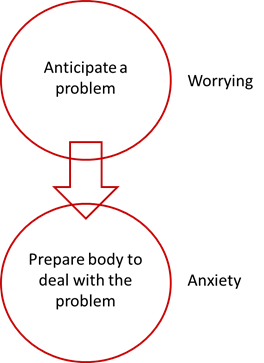
Anxiety is a normal reaction to perceiving a threat. When we believe something important to us (our lives, our jobs, our families, etc.) is threatened, our bodies prepare us to deal with this threat. Our muscles tense, our heart beats faster, our breathing may get rapid and shallow, etc. these are the physical symptoms of anxiety.

How does worrying influence anxiety?

There is a lot of research suggesting people who struggle with excessive anxiety have difficulties tolerating uncertainty. In other words they struggle with not knowing what might happen. “Worrying” is attempting to anticipate threats that may occur in the future – trying to figure out what might happen. People tend to believe that if they can just predict everything that could go wrong, they can plan and problem solve, and then they will be safe. However, our brains easily confuse real threats with imagine threats. For example, if you were extremely afraid of spiders, seeing photos of spiders, seeing videos of spiders, or just thinking about spiders might be enough to trigger anxiety – even if you know the spider in the photo is not actually inanxiety blog post the room with you. This is important because when you are worrying, you are thinking about “something bad” that could happen, and your brain gets confused and thinks the “something bad” is actually happening right now. So your brain tells your body to get ready to deal with the “something bad” right now, and as described above, we call these preparations “anxiety.” As advanced as our brains are, its responses to “something bad” happening can be overly simplistic. It doesn’t matter if the “something bad” is someone saying something mean to us or having to run away from a tiger in the bush, our brain and bodies tend to react in the same way (fight/run away/freeze). So the more we worry (think about what could go wrong/perceive a threat) the more your brain tells your body to get ready to deal with what could go wrong by becoming “anxious.”
Why do I worry so much?

Researchers Dugas and Robichaud identify five beliefs that keep people stuck in a cycle of excessive worrying. If we believe these things, we are encouraged to worry as much as possible. These beliefs are:

1)       “Worrying helps find solutions to problems.” While recognizing the problem is one part of problem solving, it is no longer helpful when we start worrying about problems with a low probability of occurring. For example, if you are going camping it makes sense to recognize that it could rain (anticipate a problem with a reasonable probability of occurring) and plan accordingly by bringing a tarp. However, it is less helpful to plan for a satellite falling from orbit and landing on your campsite. This sounds ridiculous but we often do we worry about all the things that could go wrong as opposed to what is likely to happen.

2)       “Worrying helps motivate me to get things done.” Similar to the previous rationalization for worrying, perhaps some worrying does help motivate you. It makes sense to remember you have a test coming up in a couple of weeks, so you can start studying for the test. However, when we excessively worry we can often get overwhelmed by anxiety. If we are worrying about our test in a couple of weeks, about the bus maybe being late, about our partners not actually loving us, about what we are going to get our mother for her birthday, about the assignment due next month, etc. we may experience too much anxiety and being distracting ourselves, procrastinating, using substances to calm down, or use another unhelpful coping mechanism.

3)       ‘Worrying prepares me for uncomfortable emotions.” This belief reflects the idea that if we worry about something bad happening, we will be less disappointed, sad, or guilty should that bad thing happen. Unfortunately, this belief will keep us locked in an endless pattern of worrying “just in case.”

4)       “Worrying can prevent bad things from happening.” Some people believe that if they just worry enough, “magical thinking” will prevent what we are worried about from happening. If this were true, then we would become stuck in an endless cycle of worrying about all the bad things that could happen.

5)       “Worrying is a positive part of my personality.” This is when we believe that worrying shows we are caring, loving, or conscientious. However, worrying too much can actually annoy and frustrate the people in your life, and push them away. Furthermore, there are many ways we can be caring, loving, and conscientianxiety blog post2ous without worrying.

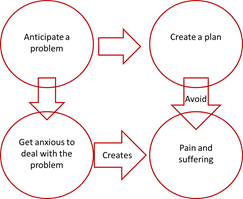
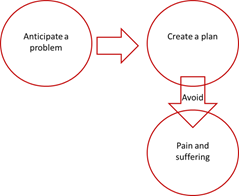
A major theme within these beliefs is the idea that worrying will somehow prevent or reduce our pain and suffering. In other words, people think that if they can just anticipate all the problems, they can create some kind of plan, which “fixes” the “problem”, which will protect us from the pain and suffering we would experience if the problem were to occur. For example, if I worry about my kid using drugs, I can create a plan to talk to them about drug use, so I can avoid the pain and suffering I would experience if my kid were to use drugs.anxiety blog post3

However, when we anticipate problems, our mind tells our body to prepare to deal with problems, it tells our body to become anxious. Most people find anxiety painful and describe it as suffering. So ironically, by anticipating problems, to avoid pain and suffering, we are actually creating our own pain and suffering.

Many people want to spend a lot of time anticipating the bad things that could happen in their lives (worrying) but don’t want the anxiety. However, our brains are not wired for this and by choosing to worry, we are indirectly choosing to have anxiety.

When is it helpful to worry?

Worrying can be helpful in some situations but we want to limit our worrying because excessive worrying will lead to excessive anxiety. For example, it can be helpful to anticipate and prepare for:

a) Things with a reasonable probability of happening,

b) Things we can reasonably do something about now or in the immediate future,

c) Things that would pose a legitimate threat to our health, safety, or goals.

If a situation meets all three of these criteria, it might be worth your worrying. For example, people often worry about public speaking. If we know we have to give a presentation in class, there is a reasonable probability we will have to speak in public. Perhaps a large portion of your grade is dependent on how you do in your presentation, so it may be important to you to do well, in which case it would be prudent to prepare thoroughly. By anticipating this challenge, we can prepare by doing our research and practicing our presentation thoroughly. If we are thinking about the challenges we may face while giving our presentation during a study session scheduled to work on your presentation, this would be helpful. However, worrying about giving your presentation is no longer helpful when you are lying in bed at 3 am wanting to sleep, because these is nothing you could reasonably do at that time and focusing on the presentation is interfering with your other important life goals (like getting a good night’s sleep). Worrying about being laughed out of the classroom and losing all your friends because you did poorly on a presentation isn’t helpful because, in my opinion, it doesn’t have a reasonable probability of occurring. It is also important to put the consequences of giving an imperfect presentation into perspective. While you might not get the grade you want, you will likely be physically fine – no one will chop your hand off for doing poorly.

How do I experience less anxiety?

This is a very old and complicated question with several different answers. For moderate to severe levels of anxiety medication can help, but medications can have side effects. Taking medication can also be relatively easy, you simply take some pills throughout your day. Other ways to reduce anxiety typically take more work, but they also have some benefits medication does not. In therapy, I usually start by recommending daily exercise, getting 8-9 hours of sleep per night, and eating a balanced diet. While people may not see the connection between these habits and their anxiety, research strongly suggests each of these interventions. These habits also come with a wide array of other benefits as well. Healthy living habits serve as the foundation upon which we can build wellness.

Then there are a number of mental exercises people can practice to reduce worrying and anxiety. One of which is called mindfulness which can be described as practicing non-judgmental awareness and acceptance of the present moment. This is when you pay attention to what is happening right now, in the room where you are, in your body, and in your mind. Then we accept the thoughts, feelings, sensations, and images in the present moment without judgement. So maybe you check-in with your body and notice some sadness, and instead of trying to get rid of the sadness because it is “bad” you accept the sadness without judging it as either good or bad. This can help reduce anxiety because when we are paying attention to the present moment, we cannot be attempting to anticipate the “bad things” that could happen in the future. As we continue to practice directing our attention to the present, this gets easier and we actually change the way our brains work.

The cognitive-behavioral therapy (CBT) approach to reducing anxiety includes changing patterns of thinking and behaving which maintain anxiety. We question the beliefs that maintain our worrying, our unhelpful ways of dealing with problems, the beliefs about our vulnerability to “bad things happening”, and our ability to cope with challenges. We largely do this through a series of activities designed to challenge unhelpful beliefs. For example, a person anxious about being in a public place will create a series of exposure exercises in which they expose themselves to their feared situations so they learn that their fear is irrational and that they can cope with being in public places. CBT is direct, short-term, and it can take a willingness to take some “risks.” There is a lot of research supporting CBT as a front-line treatment for anxiety. In my experience, CBT is most effective when the feared situation is concrete and specific. CBT can be offered in individual therapy, group therapy, self-help books, and online.

I’ve tried everything before and it hasn’t worked, now what do I do?

This question is an overgeneralization – there is no way anyone could try “everything.” Instead, it is likely that you have tried several or many things in the past and have not gotten the desired results. However, there are many different medications, many different activities that promote wellness (yoga, joining a sports team, trying a new hobby, finding a new job, journaling, etc.), and many different kinds of therapy. Even among cognitive-behavioral therapists there is a lot of variation in how therapists actually practice. If we are trying to find a reason to give up (“I’ve tried everything”), this might mean we don’t actually want to put the work in to make changes, and that is okay. There may be a time in your life when you are more ready, willing, and able to try something new. If that time comes, hopefully this article has given you some ideas you could try.

Reduce anxiety and improve your mood: Free workbooks

There are two workbooks you can now access in our “self-help” section for free.
The Making Changes workbook can help you learn about Cognitive Behavioral Therapy principles and how to apply them to your life. It can help you improve your living habits, set goals, and change your thinking.
The new Anxiety workbook can teach you about anxiety, skills to manage anxiety, and steps you can take to reduce your anxiety over time. Here is an portion from that workbook:
SUMMARY

· Anxiety is a normal human response to perceived danger.

· The more we worry, the more we are thinking about potential dangers, this then triggers the anxiety response.

· We can practice skills like box breathing, 5-4-3-2-1 sensory grounding, and progress muscle relaxation to cope with extreme anxiety.

· Cognitive behavioral therapy can help use reduce our anxiety.

· Our thoughts cause our emotions and behaviors, not situations. Therefore, our anxiety is being created by the story in our head, not the situation we are in.

· When we experience excessive anxiety we are usually engaging in unhelpful thinking styles.

· CBT teaches us to recognize our unhelpful thinking and then dispute irrational thoughts, replacing them with more helpful thoughts.

· Excessive worry fuels excessive anxiety. Sometimes we believe excessive worry can be a good thing, but these beliefs maintain worry.

· When we believe (1) “problems are threatening”, (2) “I can’t handle problems effectively”, and (3) “problems will turn out badly regardless of what I do” we are preventing effective problem solving. We can solve this by recognizing problems as a normal part of life and seeing the opportunities presented by our problems.

· A problem solving model can be used to help us effectively cope with challenges we can reasonably do something about.

· Graded exposure can be used to decrease the amount of anxiety we experience in situations. Graded exposure is a process by which we practice exposing ourselves to anxiety provoking situations, practicing and developing our skills, and gradually learning situations are not as threatening as our minds make them.

· We can improve our abilities to cope with stressors by maintaining a healthy self-care plan which includes diet, exercise, sleep, relaxation, work , socializing, thinking helpful thoughts, and goal setting.


Improve your approach to dealing with problems in life (Part 1)

The Jewish psychiatrist Viktor Frankl remembers the day he entered the camps:

Then the train shunted, obviously nearing a main station. Suddenly a cry broke from the ranks of anxious passengers, “there is a sign, Auschwitz!” Everyone’s heart missed a beat at that moment. Auschwitz – the very name stood for all that was horrible: gas chambers, crematoriums, massacres. Slowly, almost hesitatingly, the train moved on as if it wanted to spare its passengers the dreadful realization as long as possible: Aushwitz!

His book Man’s Search for Meaning tells a harrowing tale of some of the worst conditions humans have been exposed to in modern history. As I read this book for the first time, several years ago, I was mesmerized by Dr. Frankl’s seemingly endless ability to recognize the opportunities within his experiences. His beliefs about problems and suffering were infectious.

Negative Problem Orientation

Put simply, a person’s problem orientation refers to their beliefs about problems and their ability to solve problems. People with a negative problem orientation are more likely to view problems as excessively threatening, they typically doubt their ability to solve problems, and they believe negative outcomes will occur regardless of how much effort they put in to solve them. As a result of these beliefs, researchers Dugas and Robichaud suggest people with a particularly negative problem orientation are more likely to be frustrated, irritated, anxious, or depressed when they face a problem. Behaviorally, people with a negative problem orientation are more likely to procrastinate and/or avoid problem solving. As a result, they can make new problems for themselves and increase worries.

Perhaps unsurprisingly, negative problem orientation has been connected with a wide variety of mental health difficulties including generalized anxiety disorder, depression, pathological gambling, and post-traumatic stress disorder (Robichaud & Dugas, 2005).

Locus of Control

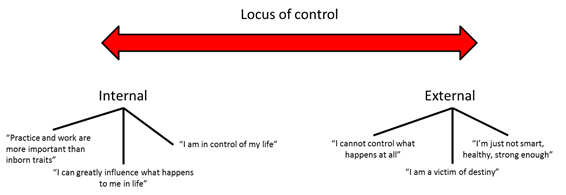
In my opinion, a person’s problem orientation plays a massive role in how they approach the world. There seems to be a large overlap between problem orientation and something, in psychology, we call “locus of control.”  Our locus of control can be described as our beliefs about how much we influence what happens in our lives. People with an “internal locus of control” typically believe they greatly influence their destiny. While people with an “external locus of control” typically believe that what happens in their lives is largely controlled by forces outside of them. Research over the last 65 years has suggested that people with an internal locus of control have greater academic success, are more motivated, are more socially mature, have less stress and depression, and live longer. They “earn more money, have more friends, stay married longer, and report greater professional success and satisfaction” (Duhigg, 2016, p. 24). So to summarize, people with an internal locus of control will usually be less threatened by problems, work harder to solve problems, and believe they can mitigate negative outcomes through effective problem solving. In other words, they have a more positive problem orientation.

locus of control

So if a negative problem orientation and an external locus of control are typically unhelpful for promoting health and wellbeing, what can we do to change?

Luckily, research suggests there are a few things we can do to improve our problem orientation and our beliefs about locus of control. Dugas and Robichaud suggest we first have to learn how to identify problems. Many clients enter therapy and believe that their emotions are the problem, they just want to be happy. However, emotions are not the problem. Emotions are data, they are just information giving you clues something is or is not working for you in life. The problem is not that you are depressed, the problem may be you are stuck in a relationship that is not good for you, it could be that your habits are not particularly healthy, it might be that you are stuck in depressive thinking habits, perhaps the problem is that you are in a concentration camp, etc. Once we can see our emotions as information, this can help you identify appropriate solutions to the real problems.

The belief that we are exceptional because we experience problems can keep us stuck. Why does this keep happening to me? Why was I the one who was dealt a bad hand in life? We can improve our problem orientations by challenging these kinds of beliefs and recognizing that experiencing problems in life is normal. Suffering is an important part of life, it is times when we suffer the most that we are motivated to adapt and grow the most.

Challenge filtering and overgeneralizing (see our cognitive distortions list). An internal locus of control and/or a negative problem orientation occurs because we are not paying enough attention to all the times your effort and practice have influenced outcomes. We conclude because we could not have possibly prevented ____________ from happening in the past, why bother trying in the future? While there is a lot in life that you cannot control, there is a massive amount that you can. By just focusing on the things we cannot control, we are underestimating the number of choices we have. When we underestimate the choices we have, we are reinforcing the belief that we are not responsible for what happens to us and this can be a very comfortable delusion to live in. However, this short term comfort comes with a price, it disempowers us and maintains a victim mentality.

Lastly, and perhaps most importantly, we can improve our problem orientation by recognizing the opportunities that are within all of the problems we experience. Every problem has opportunities associated with it. Few people illustrate this better than Viktor Frankl. While in the camps, he became very sick, and with the sickness came a far greater likelihood of being “selected” to go to the gas chambers. Despite his sickness he remembers:

We were sick and I did not have to go on parade. We could lie all day in our little corner in the hut and doze and wait for the daily distribution of bread (which, of course was reduced for the sick) and for a daily helping of soup (watered down and also decreased in quantity). But how content we were; happy in spite of everything.”

This sickness gave him the opportunity to rest. More generally, by being a prisoner within the camp, Frankl recognized he was given the opportunity to study what happens to a human under such circumstances. He was given the opportunity to understand how people find meaning and purpose even in the worst of conditions. Gordon Allport describes Frankl’s conclusions beautifully in his preface:

In the concentration camp every circumstance conspires to make the prisoner lose his hold. All the familiar goals in life are snatched away. What alone remains is “the last of human freedoms” – the ability to “choose one’s attitude in a given set of circumstances.”

Being in the camp presented many, very real and horrifying, problems. However, Frankl was also given the opportunity to choose how he was going to cope with these problems. He was given the opportunity to search for answers to some very fundamental human questions – what prevents some men from committing suicide in such horrible conditions? Why choose to live when one can simple run to the electric fences at any time? What motivates a man to treat prisoners a particular way? Etc.

When your partner says something you don’t agree with, you are being given the opportunity to practice your non-defensive communication skills. When you lose a relationship you have the opportunity to be a kind, loving, and respectful person even when things do not go your way. When you get lost, you have the opportunity to become familiar with somewhere new. When you are in a concentration camp, you have the opportunity to study how humans adapt to such horrible conditions and find meaning and purpose despite great suffering.

If you have children, it is likely they will experience their own challenges in life (divorce, trauma, accidents, health problems, etc.) and every time you experience these things, you are being given the opportunity to teach your kids how to effectively face these problems in their own lives. By recognizing the opportunities within the problems we face, we are going to be more likely to accept when problems occur and we will be more motivated to engage with our problems in a helpful way.

Duhigg, C. (2016). Smarter, faster, better: The secrets of being productive in life and business. Doubleday Canada.

Frankl, V. E. (1959). Man’s search for meaning: An introduction to logotherapy. Washington Square Press, New York.

Robichaud, M., Dugas, M. (2005). Negative problem orientation (part I): Psychometric properties of a new measure. Behavior Research and Therapy (43)3, 391-401.

An introduction to unhelpful thinking styles


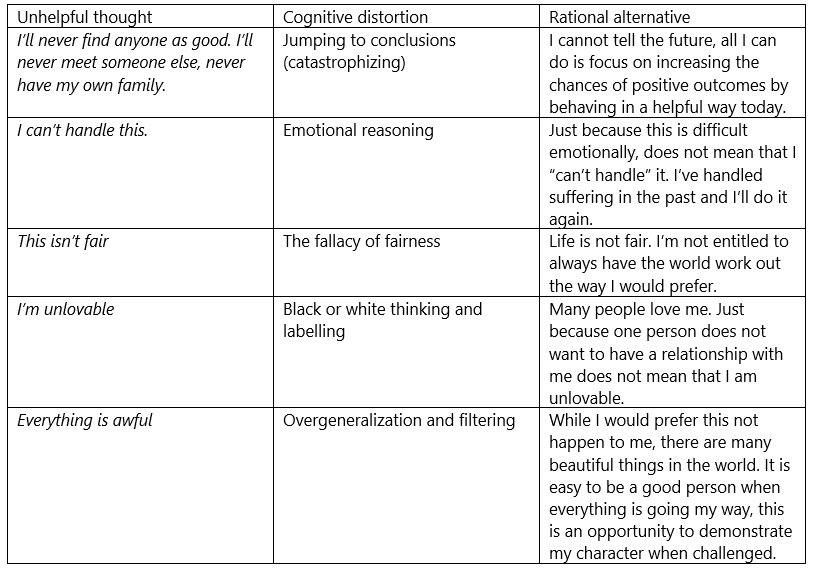
I’ll never find anyone as good. I’ll never meet someone else, never have my own family. I can’t handle this. This isn’t fair. I’m unlovable. Everything is awful.

 Most people are familiar with thoughts like these. When under intense stress, like the loss of a significant relationship, our minds often go to those dark places. Sometimes our thoughts are irrational and since these thoughts are extreme, the emotions they evoke are also irrational. I tell clients all the time that I do not want them to be an unfeeling robot. If we suffer a significant loss we should feel some grief, if we are treated unfairly it is normal to feel angry, and it is okay to be sad sometimes. However, sometimes we have emotional reactions which are disproportionate to the situation. It is these intense emotional reactions which usually lead to behavior that is inconsistent with our values and goals. Since we know emotions are caused by thinking, we can reduce the intensity of irrational emotional responses by changing the irrational thinking evoking them.


“There are no facts, only interpretations.”

Friedrich Nietzsche

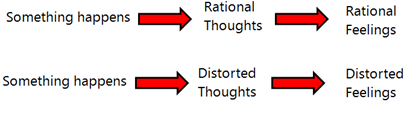
 Dr. Aaron Beck is widely considered the father of Cognitive Therapy. He was trained in the classical forms of therapy pioneered by Sigmund Freud (Psychodynamic Therapy). Psychodynamic Theory suggests that our thoughts are the product of unconscious or subconscious forces within our psyche. In other words, this theory suggests that our thoughts mean something about us. While at a dinner party, Dr. Beck met a woman and this interaction would change psychotherapy forever. The story is that this woman explained she was depressed and she believed that no one loved her/she was unlovable. Instead of going down the usual therapeutic road, Dr. Beck decided to try something different. He asked her to evaluate the evidence for her beliefs. To her surprise, the woman was able to recognize that there were several people in her life that loved her and when she focused on this, her sadness dissipated (listen to this great podcast for more information). While working with severely depressed patients in his clinic, he noticed several common thinking errors within the thoughts of his patients. Today these thinking errors are called “cognitive distortions.” By identifying and challenging cognitive distortions, our thinking can become more rational and as a result our emotions will also become more rational.

rational thoughts and feelings

In the following table I demonstrate how the “three column technique” can be used to challenge cognitively distorted thoughts. In this exercise you identify your distressing thoughts, identify cognitive distortions taking place, and try and come up with more rational thoughts.

Cog distortions example

While a full description of all of the common cognitive distortions is beyond the scope of a single blog post, I will post a worksheet I use with clients on the self-help resources page that goes over them in greater detail.

When I work with clients, I typically go over a list of some common cognitive distortions. The vast majority of clients are able to recognize that they have many thoughts consistent with these unhelpful thinking styles. Clients struggling with depression usually filter out all of the good things in life, those struggling with anxiety are often plagued with catastrophizing, and people overwhelmed with anger desperately want the world to work the way they want (should/musts and the fallacy of fairness). We all think cognitively distorted thoughts sometimes, it is normal. The refreshing thing about thinking habits is that they can be changed. The first step to changing our thinking is building our awareness of our thoughts. Simply reading this post and the list of common cognitive distortions on the self-help page can help you with becoming more aware of your unhelpful thinking patterns.

Personally, learning about cognitive distortions has changed my life. Challenging my unhelpful thoughts insulates me from distress that comes with being a human being. When I am irrationally frustrated about something (like a hockey game) I pull out my journal and practice these skills. When I go through a more significant challenge (bereavement, financial concerns, trauma, etc.) I use the same skills. Before learning these theories and techniques, I would stay up for hours on end, just laying in bed ruminating about things. Now I am able to process what is going on for me and let it go. Hopefully with some practice, you will be able to do the same.