Improve your approach to dealing with problems in life (Part 1)

The Jewish psychiatrist Viktor Frankl remembers the day he entered the camps:

Then the train shunted, obviously nearing a main station. Suddenly a cry broke from the ranks of anxious passengers, “there is a sign, Auschwitz!” Everyone’s heart missed a beat at that moment. Auschwitz – the very name stood for all that was horrible: gas chambers, crematoriums, massacres. Slowly, almost hesitatingly, the train moved on as if it wanted to spare its passengers the dreadful realization as long as possible: Aushwitz!

His book Man’s Search for Meaning tells a harrowing tale of some of the worst conditions humans have been exposed to in modern history. As I read this book for the first time, several years ago, I was mesmerized by Dr. Frankl’s seemingly endless ability to recognize the opportunities within his experiences. His beliefs about problems and suffering were infectious.

Negative Problem Orientation

Put simply, a person’s problem orientation refers to their beliefs about problems and their ability to solve problems. People with a negative problem orientation are more likely to view problems as excessively threatening, they typically doubt their ability to solve problems, and they believe negative outcomes will occur regardless of how much effort they put in to solve them. As a result of these beliefs, researchers Dugas and Robichaud suggest people with a particularly negative problem orientation are more likely to be frustrated, irritated, anxious, or depressed when they face a problem. Behaviorally, people with a negative problem orientation are more likely to procrastinate and/or avoid problem solving. As a result, they can make new problems for themselves and increase worries.

Perhaps unsurprisingly, negative problem orientation has been connected with a wide variety of mental health difficulties including generalized anxiety disorder, depression, pathological gambling, and post-traumatic stress disorder (Robichaud & Dugas, 2005).

Locus of Control

In my opinion, a person’s problem orientation plays a massive role in how they approach the world. There seems to be a large overlap between problem orientation and something, in psychology, we call “locus of control.”  Our locus of control can be described as our beliefs about how much we influence what happens in our lives. People with an “internal locus of control” typically believe they greatly influence their destiny. While people with an “external locus of control” typically believe that what happens in their lives is largely controlled by forces outside of them. Research over the last 65 years has suggested that people with an internal locus of control have greater academic success, are more motivated, are more socially mature, have less stress and depression, and live longer. They “earn more money, have more friends, stay married longer, and report greater professional success and satisfaction” (Duhigg, 2016, p. 24). So to summarize, people with an internal locus of control will usually be less threatened by problems, work harder to solve problems, and believe they can mitigate negative outcomes through effective problem solving. In other words, they have a more positive problem orientation.
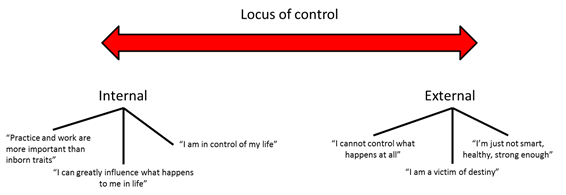
locus of control

So if a negative problem orientation and an external locus of control are typically unhelpful for promoting health and wellbeing, what can we do to change?

Luckily, research suggests there are a few things we can do to improve our problem orientation and our beliefs about locus of control. Dugas and Robichaud suggest we first have to learn how to identify problems. Many clients enter therapy and believe that their emotions are the problem, they just want to be happy. However, emotions are not the problem. Emotions are data, they are just information giving you clues something is or is not working for you in life. The problem is not that you are depressed, the problem may be you are stuck in a relationship that is not good for you, it could be that your habits are not particularly healthy, it might be that you are stuck in depressive thinking habits, perhaps the problem is that you are in a concentration camp, etc. Once we can see our emotions as information, this can help you identify appropriate solutions to the real problems.

The belief that we are exceptional because we experience problems can keep us stuck. Why does this keep happening to me? Why was I the one who was dealt a bad hand in life? We can improve our problem orientations by challenging these kinds of beliefs and recognizing that experiencing problems in life is normal. Suffering is an important part of life, it is times when we suffer the most that we are motivated to adapt and grow the most.

Challenge filtering and overgeneralizing (see our cognitive distortions list). An internal locus of control and/or a negative problem orientation occurs because we are not paying enough attention to all the times your effort and practice have influenced outcomes. We conclude because we could not have possibly prevented ____________ from happening in the past, why bother trying in the future? While there is a lot in life that you cannot control, there is a massive amount that you can. By just focusing on the things we cannot control, we are underestimating the number of choices we have. When we underestimate the choices we have, we are reinforcing the belief that we are not responsible for what happens to us and this can be a very comfortable delusion to live in. However, this short term comfort comes with a price, it disempowers us and maintains a victim mentality.

Lastly, and perhaps most importantly, we can improve our problem orientation by recognizing the opportunities that are within all of the problems we experience. Every problem has opportunities associated with it. Few people illustrate this better than Viktor Frankl. While in the camps, he became very sick, and with the sickness came a far greater likelihood of being “selected” to go to the gas chambers. Despite his sickness he remembers:

We were sick and I did not have to go on parade. We could lie all day in our little corner in the hut and doze and wait for the daily distribution of bread (which, of course was reduced for the sick) and for a daily helping of soup (watered down and also decreased in quantity). But how content we were; happy in spite of everything.”

This sickness gave him the opportunity to rest. More generally, by being a prisoner within the camp, Frankl recognized he was given the opportunity to study what happens to a human under such circumstances. He was given the opportunity to understand how people find meaning and purpose even in the worst of conditions. Gordon Allport describes Frankl’s conclusions beautifully in his preface:

In the concentration camp every circumstance conspires to make the prisoner lose his hold. All the familiar goals in life are snatched away. What alone remains is “the last of human freedoms” – the ability to “choose one’s attitude in a given set of circumstances.”

Being in the camp presented many, very real and horrifying, problems. However, Frankl was also given the opportunity to choose how he was going to cope with these problems. He was given the opportunity to search for answers to some very fundamental human questions – what prevents some men from committing suicide in such horrible conditions? Why choose to live when one can simple run to the electric fences at any time? What motivates a man to treat prisoners a particular way? Etc.

When your partner says something you don’t agree with, you are being given the opportunity to practice your non-defensive communication skills. When you lose a relationship you have the opportunity to be a kind, loving, and respectful person even when things do not go your way. When you get lost, you have the opportunity to become familiar with somewhere new. When you are in a concentration camp, you have the opportunity to study how humans adapt to such horrible conditions and find meaning and purpose despite great suffering.

If you have children, it is likely they will experience their own challenges in life (divorce, trauma, accidents, health problems, etc.) and every time you experience these things, you are being given the opportunity to teach your kids how to effectively face these problems in their own lives. By recognizing the opportunities within the problems we face, we are going to be more likely to accept when problems occur and we will be more motivated to engage with our problems in a helpful way.

Duhigg, C. (2016). Smarter, faster, better: The secrets of being productive in life and business. Doubleday Canada.

Frankl, V. E. (1959). Man’s search for meaning: An introduction to logotherapy. Washington Square Press, New York.

Robichaud, M., Dugas, M. (2005). Negative problem orientation (part I): Psychometric properties of a new measure. Behavior Research and Therapy (43)3, 391-401.
Worry – The illusion of action


What if I lose my job? If I lose my job then, I won’t be able to pay rent or afford food. Then I’ll have to move back in with my parents, or worse!- I’ll be homeless. I can’t get fired, oh please god, I need this job or I’m in real trouble. What if I do lose it though? I won’t be able to pay off my debt either, then I’ll get even more interest or I’ll damage my credit, and I’ll be in a financial hole for the rest of my life.


These thoughts may seem a little excessive to some people, but many of us have had worries like this countless times – usually when our guard is down, when we are tired, lying in bed with nothing to distract us. What is it about worry that can be so difficult to control? Researchers Rodebaugh and Heimberg suggest that worry “acts as a trick the person is playing on himself or herself to provide the illusion of action, when useful action seems impossible.” In other words, in our minds, worry resembles problem solving or planning. We convince ourselves that if we just worry enough, we will be better able to prevent “something bad” from happening or we will be better able to cope if this “something bad” does happen.

However, worry is not problem solving or planning. Worry is simply thinking about a problem or fear, it is not a productive attempt to create solutions. Worry typically leads to anxiety, which is a physical reaction priming your body to deal with threats, it is preparing you to run away and/or fight. Now in some situations this is helpful, but in the vast majority of situations in modern society, we do not need to run away or fight. Therefore, this is an inappropriate and unnecessary reaction. Sometimes the first step in overcoming worry is actually accepting that worrying is not helping us. Moreover, in many situations worrying, and the associated anxiety, is actually reducing our ability to cope with challenges. Many clients enter therapy and want to get rid of the suffering cause by anxiety without having to stop worrying, but this is an unrealistic expectation. So long as we keep our pattern of worrying, we will keep our pattern of feeling anxious.

Cognitive model of GAD

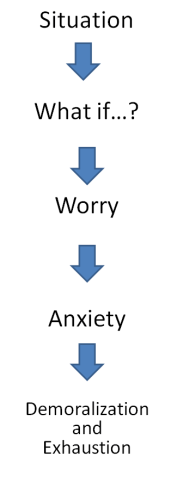
There are several different types of anxiety. One such type is called “generalized anxiety.” People that struggle with generalized anxiety worry more than most people about everyday things, and have trouble controlling it. Generalized anxiety can keep you awake at night or make you feel sick. Sometimes people with generalized anxiety refer to themselves as “worriers.” The Cognitive Model of Generalized Anxiety Disorder, created by Dugas and Robichaud, illustrates the connection between situations, wondering “what if something bad happens?”, worry, anxiety, and demoralization/exhaustion.

So if we accept that worry is not particularly helpful for us, and we want to change this pattern of worrying, what can we do?

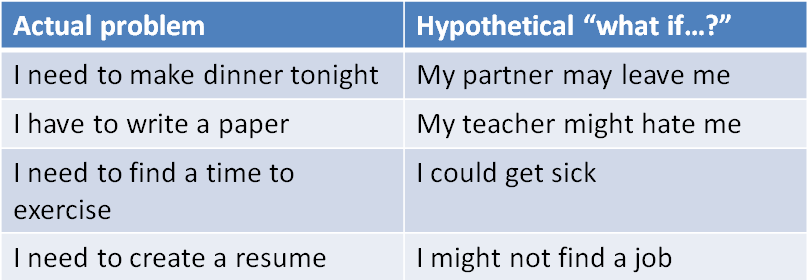
According to many CBT therapists, the first step in overcoming anxiety is understanding our worries. We can do this by writing down what we are worried about several times throughout the day. Then you take this list of worries and divide them into actual current problems and hypothetical “what if…?” worries.


worries

Now you might look at this list and think “but I could get sick!” or “but my partner might leave me!” Yes, but in neither of these situations will worrying help problem solve. You might also look at these lists and think “but my worrying helps motivate me! If I quit worrying, won’t I lose my motivation??” Let me answer this question with a question – many, many, many very motivated and successful people do not worry very much, so why do you have to play by different rules? Also, we can problem solve, set goals, and plan all without worrying, don’t get sucked into the tricks worrying is trying to play on you. One huge difference between the things in the “actual problem” category is that the things on that list are current and actionable. You can choose to make something for dinner, choose to write a paper, choose to schedule a time to exercise, and choose to create a resume. The things on the “what if…?” list are uncertain because they are in the future and greatly influenced by forces beyond your control. It would be a beautiful world if we could just choose to not get sick or choose to have everyone like you.

God grant me the serenity to accept the things I cannot change,

Courage to change the things I can,

And the wisdom to know the difference.

The Serenity Prayer.

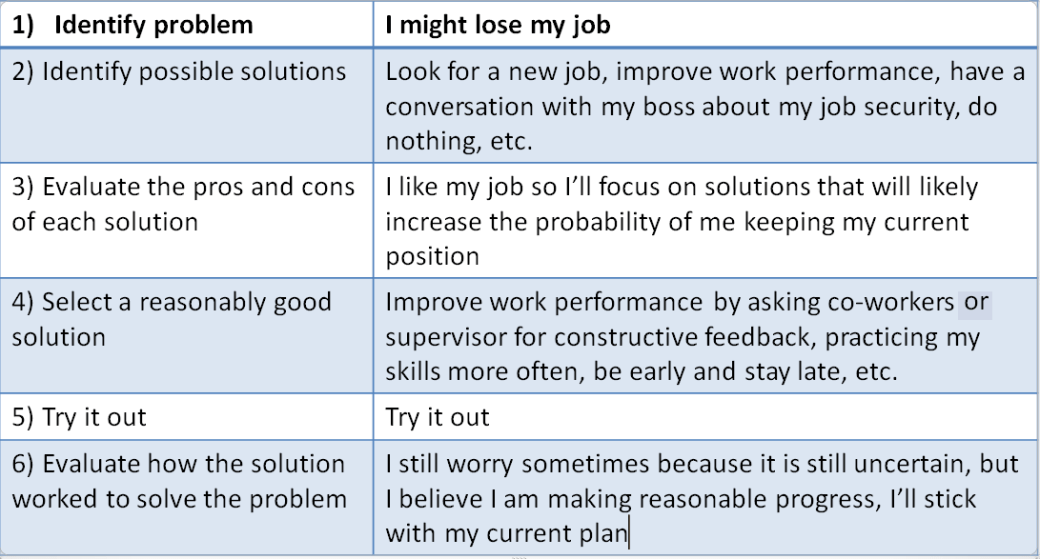
In the sections above, I suggested that worrying is not problem solving, this begs the question “what is problem solving?” In problem solving we first (a) identify the problem, (b) identify possible solutions to a problem, (c) evaluate the pros and cons of each solution, (d) select a reasonably good solution, (e) try it out, (f) evaluate how the solution worked to solve the problem, and (g) repeat this process as necessary. I strongly recommend you write these steps down for your more serious concerns, or chances are when you worry about the problem at 2 in the morning you won’t remember the plan to created yesterday to solve the problem.

problem solving example.PNG

The exercise of identifying which worries are actual problems that we can do something about, from those worries that are beyond our control can be a powerful tool for challenging unhelpful thinking patterns. As we become more aware of these unhelpful patterns, we can replace unhelpful thoughts with more helpful ones. When we think “I might lose my job” we can challenge this worry by thinking “yes, it is possible, however I cannot control this. Instead I’m going to focus on things I can do to decrease the probability of this happening – such as improving my performance.

Unfortunately, there are times where there is nothing we can do to prevent a catastrophe from occurring. In those situations, we are faced with a choice – continue to worry (and suffer) or accept the uncertainty. This can be extremely difficult for some people. One way we can increase our tolerance of the uncertainty is to review the evidence that the catastrophe will take place. What is the evidence the catastrophe has taken place? What are the actual probabilities of the catastrophe occurring? Will your worrying change the probability?

As is usually the case for the topics I choose to write about, this is a huge topic that has been explored in many studies, articles, and books. However, I hope this article helps expand your understanding and will be of some help.

If anyone has any questions or comments, please e-mail!

An introduction to unhelpful thinking styles


I’ll never find anyone as good. I’ll never meet someone else, never have my own family. I can’t handle this. This isn’t fair. I’m unlovable. Everything is awful.

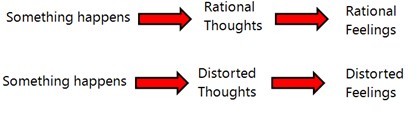
 Most people are familiar with thoughts like these. When under intense stress, like the loss of a significant relationship, our minds often go to those dark places. Sometimes our thoughts are irrational and since these thoughts are extreme, the emotions they evoke are also irrational. I tell clients all the time that I do not want them to be an unfeeling robot. If we suffer a significant loss we should feel some grief, if we are treated unfairly it is normal to feel angry, and it is okay to be sad sometimes. However, sometimes we have emotional reactions which are disproportionate to the situation. It is these intense emotional reactions which usually lead to behavior that is inconsistent with our values and goals. Since we know emotions are caused by thinking, we can reduce the intensity of irrational emotional responses by changing the irrational thinking evoking them.


“There are no facts, only interpretations.”

Friedrich Nietzsche

 Dr. Aaron Beck is widely considered the father of Cognitive Therapy. He was trained in the classical forms of therapy pioneered by Sigmund Freud (Psychodynamic Therapy). Psychodynamic Theory suggests that our thoughts are the product of unconscious or subconscious forces within our psyche. In other words, this theory suggests that our thoughts mean something about us. While at a dinner party, Dr. Beck met a woman and this interaction would change psychotherapy forever. The story is that this woman explained she was depressed and she believed that no one loved her/she was unlovable. Instead of going down the usual therapeutic road, Dr. Beck decided to try something different. He asked her to evaluate the evidence for her beliefs. To her surprise, the woman was able to recognize that there were several people in her life that loved her and when she focused on this, her sadness dissipated (listen to this great podcast for more information). While working with severely depressed patients in his clinic, he noticed several common thinking errors within the thoughts of his patients. Today these thinking errors are called “cognitive distortions.” By identifying and challenging cognitive distortions, our thinking can become more rational and as a result our emotions will also become more rational.

rational thoughts and feelings

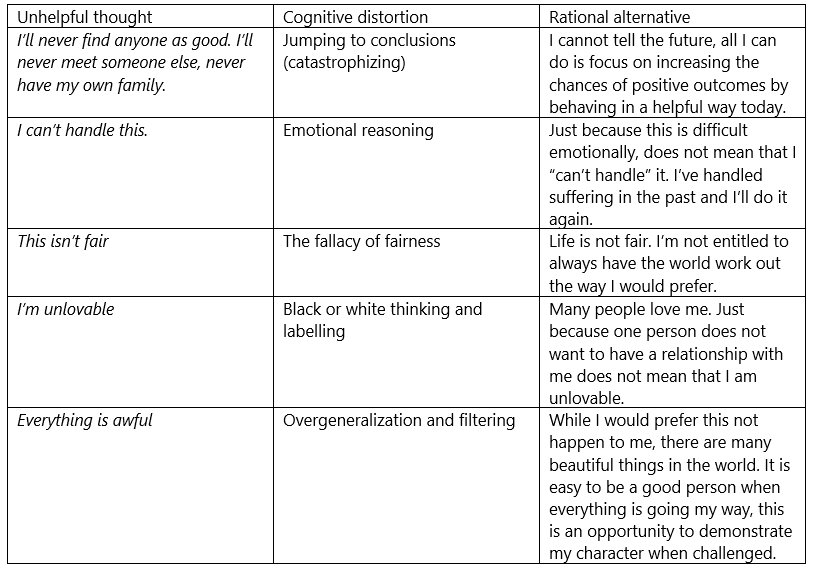
In the following table I demonstrate how the “three column technique” can be used to challenge cognitively distorted thoughts. In this exercise you identify your distressing thoughts, identify cognitive distortions taking place, and try and come up with more rational thoughts.

Cog distortions example

While a full description of all of the common cognitive distortions is beyond the scope of a single blog post, I will post a worksheet I use with clients on the self-help resources page that goes over them in greater detail.

When I work with clients, I typically go over a list of some common cognitive distortions. The vast majority of clients are able to recognize that they have many thoughts consistent with these unhelpful thinking styles. Clients struggling with depression usually filter out all of the good things in life, those struggling with anxiety are often plagued with catastrophizing, and people overwhelmed with anger desperately want the world to work the way they want (should/musts and the fallacy of fairness). We all think cognitively distorted thoughts sometimes, it is normal. The refreshing thing about thinking habits is that they can be changed. The first step to changing our thinking is building our awareness of our thoughts. Simply reading this post and the list of common cognitive distortions on the self-help page can help you with becoming more aware of your unhelpful thinking patterns.

Personally, learning about cognitive distortions has changed my life. Challenging my unhelpful thoughts insulates me from distress that comes with being a human being. When I am irrationally frustrated about something (like a hockey game) I pull out my journal and practice these skills. When I go through a more significant challenge (bereavement, financial concerns, trauma, etc.) I use the same skills. Before learning these theories and techniques, I would stay up for hours on end, just laying in bed ruminating about things. Now I am able to process what is going on for me and let it go. Hopefully with some practice, you will be able to do the same.