The Life Philosophy of Rational Emotive Therapy

All counselling theories (narrative therapy, psychoanalysis, DBT, Albert_Ellismindfulness based theories, CBT, etc.) all have underlying philosophies about how human beings “work”, what is “healthy”, and how people can remove barriers to become more “healthy.”  People might be surprised to know there are a number of different variations of cognitive-behavioral therapy (CBT). One type of CBT is called Rational-Emotive Therapy (RET) and it was created by Albert Ellis. This article describes the underlying philosophies of RET and has been adapted from Bill Borcherdt’s book “Think Straight! Feel Great! 21 guides to Emotional Self-Control.”

RET is designed to teach people:

1. Feelings are not externally caused.

  • Our emotions and moods are caused by our thinking, not what happens to us, what others say, or our environment. We interpret the things that happen to us, and our emotions are caused by these interpretations. This is important because you can learn to control what you think and when you can do this, you can control how you feel.

2. Dissatisfaction is not the same as disturbance.

  • Things will inevitably frustrate, deprive, and inconvenience you, but you disturb yourself by insisting that dissatisfactions should not exist.

3. All rejection is self-rejection and is self-inflicted.

  • People may evaluate you and choose to not associate with you, but your feelings of embarrassment, shame, anxiety, and sadness are caused by your thoughts like “because this person does not want to associate with me, this means I’m no good!”

4. Recognize preferences are not demands.

  • While it is normal to have preferences, emotional disturbances occur when we demand to have our preferences met.

5. Nothing “has to be.”

  • You do not have to survive; you choose to survive because you want to survive. When we label “wants” as “needs” this creates desperation and a sense of urgency which can lead to distress.

6. Distinguish appropriate and inappropriate feelings.

  • Intense emotions often get in the way of working towards our goals. It is normal to get frustrated, annoyed, disappointed, apprehensive, and sad but it is often unhelpful to become enraged, devastated, panicked, ashamed, and depressed.

7. Put yourself first and others in a close second without shame or guilt.

  • This promotes happiness and joy, which can make you more fun to be around.

8. Avoid evaluating humans.

  • Humans are too complex and ever-changing to judge or score. Neither yourself nor other people are simply “good” or “bad.”

9. Do the “right thing” for the “right reason.”

  • Pursue goals and accomplishments because they provide you with happiness or some practical improvement to your life, rather than inflating your ego or providing you with approval from others.

10. Avoid overemphasizing change.

  • Learn to co-exist with your problems and imperfections, rather than putting undue pressure of yourself to overcome all problems.

11. Attempt to get better, rather than merely feeling better.

  • What feels good isn’t always good for us. For example, expressing intense unwanted emotions, like anger, might feel good at the time, but it might move us away from our life goals.

12. Abandon absolute thinking.

  • Identify, challenge, and uproot these three core irrational ideas:
    1. “I must do perfectly well or I’m completely worthless,”
    2. “You must treat me perfectly, with no lapses in kindness and consideration, or you are completely worthless.”
    3. “Life must make it easy on me to reach my goals and accomplishments.”

I suspect people will see some common themes in these recommendations. Generally, RET emphasizes personal responsibility and choice, it suggests that we are responsible for our emotional reactions and we can change our emotions, by changing what and how we think. RET also recommends we unconditionally accept our “self” while judging our emotional reactions as “appropriate” or “inappropriate”, which I think is an interesting idea. While I do not choose to use this terminology with my clients, I agree that intense emotions can interfere with our attempts to achieve our goals.

Most clients are resistant to making changes in their lives, usually for a variety of different Albert_Ellis and gloriareasons. People tend to want to minimize their choices and responsibility by suggesting they have no control over what they think or feel. There are several old videos of Albert Ellis working with clients on YouTube, and he has a very direct and almost confrontational style that I believe is reflected in the uncompromising philosophy of RET (click here for a classical example of RET at work). I’m not saying the advice listed above is bad advice, just that I suspect giving this advice in a way that clients could receive it non-defensively could take some tact.

Perfectionism: Life-satisfaction and coping with challenges

People with anxiety and panic frequently tell themselves “I must do perfectly well” then ask themselves some version of “will I do perfectly well” and the answer is always “no.” After they have avoided the task, or tried and failed to meet their hopes, they then become depressed because they tell themselves they did not do as well as they “should” have done. These are some of the claims made by one of the most influential contributors to counselling psychology in history, Albert Ellis. (See here)

While, I’m not bold enough to claim that perfectionism is the core of mental illness, the majority of my clients report high levels of perfectionism. There does seem to be a real connection between anxiety, depression, and perfectionism. Therefore, this article delves into some modern research on perfectionism, how to know if you might practice unhelpful perfectionism, and what you can do if you are a perfectionist, to live a more satisfied life.

Perfectionism

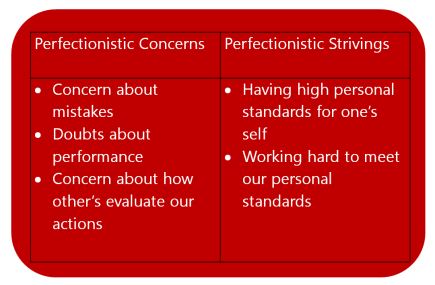
According to research, there are two dimensions to perfectionism: perfectionistic concerns and perfectionistic strivings.

concerns-vs-striving

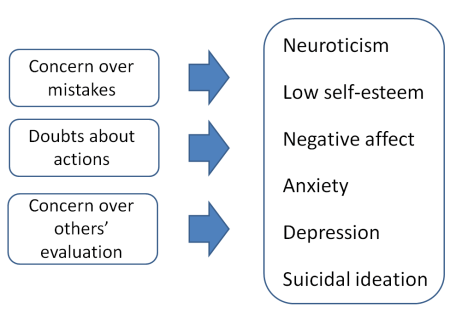
While these two dimensions are related, they are not the same thing and you can have one without high levels of the other. In other words, you can have high personal standards and work to meet those standards, without over-focusing on mistakes, excessively doubting your performance, or being very concerned about what other people may think. Research shows people who report high levels of perfectionistic concerns also typically report lower life satisfaction, neuroticism, low self-esteem, negative affect, anxiety, depression, and suicidal ideation. While people who report high levels of perfectionistic strivings, without high levels of perfectionistic concerns, report higher levels of conscientiousness, positive affect (they are generally happier), endurance, and academic performance (Stoeber & Otto, 2006).

1

When working with clients, I often hear rationalizations like “my perfectionism motivates me to work harder” or “I have to be a perfectionist or something really bad might happen.” The research described above does suggest that there are a number of benefits to having high personal standards and working hard to achieve those standards. However, when we are overly focused on making mistakes, doubting our actions, and focusing on what others think, we lose the positive benefits of our perfectionism. For the remainder of this article, I’ll refer to being overly concerned about mistakes, doubting ourselves, and being focused on how others might evaluate our performance (perfectionistic concerns) as “unhelpful perfectionism.”

Interestingly, unhelpful perfectionism is a recipe for low life satisfaction regardless of how well we actually do. In a study from Pennsylvania State University, 273 students reported engaging in unhelpful perfectionism led to less satisfaction with grades, regardless of how well they did (Grzegorek, Slaney, Franze, & Rice, 2004). In other words, even if they met their high personal standards, they were still unsatisfied if they were overly focused on making concerns, doubting their actions, and focusing on what others think.

How to know if you might practice unhelpful perfectionism

People that practice unhelpful perfectionism might claim:

  • If I fail at work/school, I am a failure as a person
  • I should be upset if I make a mistake
  • I hate being less than the best at things
  • If I do not do as well as other people, it means I am an inferior human being
  • Even when I do something very carefully, I often feel that it is not quite right
  • I usually have doubts about the simple everyday things I do
  • I tend to get behind in my work because I repeat things over and over
  • I find it difficult to meet others’ expectations of me
  • The better I do, the better I’m expected to do
  • Anything I do that is less than excellent will be seen as poor work by those around me
  • My family expects me to be perfect

These are items from two measures of perfectionism, the Frost Multidimensional Perfectionism Scale (Frost et al., 1990) and the Multidimensional Perfectionism Scale (Hewitt & Flett, 2004) and they reflect concern about mistakes, doubts about actions, and concern about other people’s evaluations. Beliefs and behaviors like these tend to interfere with a person being satisfied in life.

 Increasing satisfaction as a perfectionist

In 2011, two researchers from the University of Kent, Joachim Stober and Dirk P. Janssen, wanted to better understand the relationship between perfectionism, how people typically coped with stresses in their lives, and the amount of satisfaction they generally felt at the end of the day. They found people reporting high levels of unhelpful perfectionism seemed to cope with stressors in their lives in similar ways, and these coping mechanisms were contributing to lower satisfaction. People who reported a lot of unhelpful perfectionism reported typically trying to cope with stresses by criticizing themselves or blaming themselves for the “bad things” that happen to them. Unsurprisingly, self-criticism was associated with diminished satisfaction.

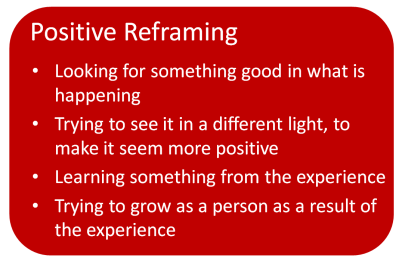
Alternatively, people who reported high levels of unhelpful perfectionism reported more satisfaction when they used a coping mechanism “positive reframing” (aka “positive reinterpretation”). These people attempted to cope with challenges by “trying to see it in a different light, to make it seem more positive” or “looking for something good in what is happening” (Carver, 1997).

positive-reframing

Two other ways of trying to cope with perceived failures were related to high levels of satisfaction, acceptance (“accepting the reality of the fact that it has happened”) and humor (“making fun of the situation”). Although, these coping mechanisms seemed to be less effective for people reporting high levels of unhelpful perfectionism.

Positive reframing has been explored in great detail in a multitude of studies over the last 30 years. Back in 1984 Lazarus and Folkam explained that positive reframing allowed people to manage their distress when challenged so they could continue with effective problem solving. This combination of positive reframing and actively trying to deal with stressors in an effective way can be an incredibly useful way to handle challenging situations in life.

Summary

We can have high personal standards and work hard to achieve these standards without over-focusing on our mistakes, excessively doubting your performance, or being very concerned about what other people may think. Indeed having high personal standards is associated with better life satisfaction. However, when we engage in unhelpful perfectionism it leads to reduced life satisfaction, neuroticism, low self-esteem, negative affect, anxiety, depression, and suicidal ideation.

Examples of unhelpful perfectionism include claiming things like:

  • If I fail at work/school, I am a failure as a person
  • Even when I do something very carefully, I often feel that it is not quite right
  • Anything I do that is less than excellent will be seen as poor work by those around me

However, even if we engage in unhelpful perfectionism we can experience greater satisfaction in life, by attempting to cope with challenges by seeing challenges as opportunities, focusing on what we learned from challenging experiences, and looking for something good in what has happened. By thinking about problems in this proactive way, we are better able to engage in effective problem solving.