Overcoming Anxiety and Avoidance

Although this will likely reduce the number of “likes” I get for this post, I believe it is important to begin with some honesty. Overcoming anxiety is hard work. Most people want a simple and easy answer that can make all of their suffering go away. However, for every complicated and messy problem there are many simple and easy answers that are ineffective. For example, in Canada the use of antidepressants increased over 450% between 1981 and 2000, but the demand for mental health services has never been higher. This post is not an “8 easy steps to being less anxious” kind of post, it is more of a “if you work really hard, stay determined despite set-backs, and keep an open-mind about trying new things you may be able to make some real improvements to your life” kind of post.

Anxiety and Avoidance

Anxiety is a normal reaction to perceived threats. However, when we have a tendency to focus on threatening situations, the problems in our lives, we are fueling excessive amount of anxiety. One way we attempt to reduce the amount of anxiety we experience is by avoiding challenging situations. However, avoidance prevents us from overcoming our fears. Furthermore, as we avoid more and more things, our lives become more and more restricted.

For example, if you had social anxiety and were terrified of 1talking to authority figures, you would likely experience anticipatory anxiety before you spoke to people of authority, then when you did have to talk to someone of authority (exposing yourself to the feared situation) your anxiety would likely spike. Then when you avoid the situation by promptly leaving, your anxiety will naturally go down. Unfortunately, when we cope with anxiety by avoiding challenging situations we cannot challenge our assumptions that the situation is dangerous, we cannot challenge our assumptions that we cannot handle the stressful situation, nor can we learn how to handle the situation more effectively. So then the next time we exposure ourselves to the stressful situation we experience a similar amount of anxiety.
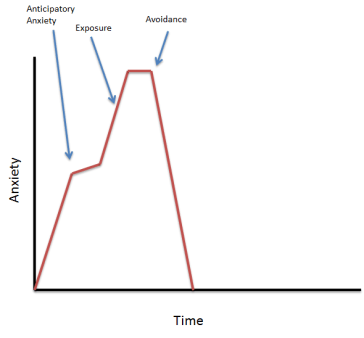
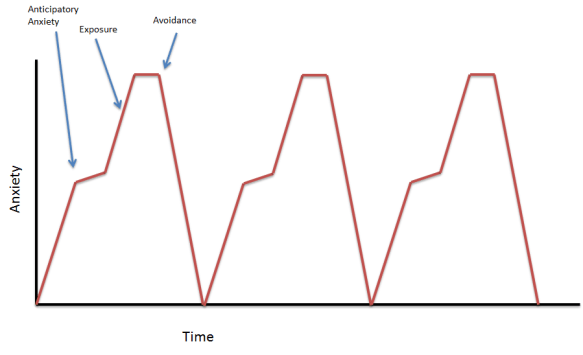
2

Overcoming anxiety can be accomplished a number of ways. However, research strongly suggests that one of the most effective strategies for overcoming anxiety is something called “exposure therapy.” Exposure therapy rests on the premise that if we can expose ourselves to our anxiety provoking situations in a certain way, we can learn: the situation isn’t as dangerous as we assume, we can handle the challenging situation, and we can practice skills to better handle similar situations in the future.
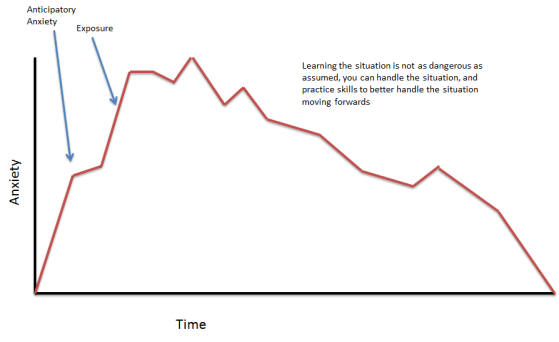
3

Exposure therapy

  • Begin by creating a list of situations you avoid
  • Rate how much anxiety you suspect you will experience in each of these situations on a scale from 0-100
  • Select a situation that will provoke a small amount of anxiety – set yourself up for success
  • Create a plan to expose yourself to this situation –when? Where?
  • Expose yourself to the situation
  • When you are in the situation try and pay attention to what is going on around you as opposed to what is happening in your body or distracting yourself (looking at your phone, talking to a friend, reading a book, etc.)
  • Stay in the situation until your anxiety has diminished, do not just leave when you feel some anxiety
  • After your anxiety has gone down, ask yourself what you have learned about how dangerous the situation was, what you have learned about your ability to cope (did you survive?), and some skills you could practice to handle the situation more competently in the future
  • If you notice yourself going over and over the situation in your mind, distract yourself by doing something engaging
  • When you are able, expose yourself to the same situation again and again until you do not feel very much anxiety at all in that situation
  • Once you have completed the first anxiety provoking situation, move on to another situation on your list of anxiety provoking situations and repeat this process

By exposing ourselves to anxiety provoking situations appropriately, we are able to reduce the amount of anxiety experienced when we face similar situations in the future.
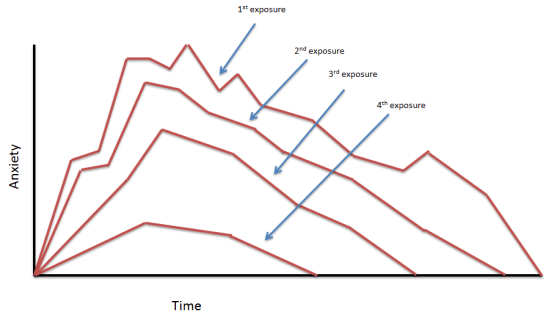
4

Some notes about exposure therapy:

Exposure therapy can be immensely effective for anxiety created by many different situations. Personally, I have seen clients make radical changes in only a small number of sessions when they are committed to their exposure plan. However, it is important to remember than some situations are actually dangerous and we are not always exaggerating the danger in our minds. Therefore, I do not encourage people to behave recklessly, for example standing in a busy highway, going down dark alleys at night, or committing any crimes. Also, this article only describes one type of exposure therapy, something called “in vivo” exposure therapy and this type of exposure therapy cannot be used to overcome some anxiety provoking situations. Obviously, we cannot expose ourselves to our fear of our own death (at least not more than once), to fears of loved ones dying, or to fears of natural disasters. For these types of hypothetical fears, we may need to practice something called “imaginal exposure” which is not described in this article.

Some notes for therapists:

Many clients struggle with creating the motivation to engage with exposure therapy. When we are distressed we often resort to coping mechanisms that are familiar to us, even if they are not helpful. It can be useful to go slow with clients and discuss the costs and benefits of avoidance. Encourage the client to consider what their life may be like if they continue to avoid anxiety provoking situations indefinitely and/or consider the opportunities their avoidance may have already cost them. Remember, it is not our job to convince the client to do anything. Instead we are there to help them make informed decisions. If the client chooses to continue to avoid, while knowing the consequences of this decision, that is their choice and that should be respected.

Processing what the client has learned from exposing themselves is just as important as collaborating with the client to design the exposure activity. “what did you learn from exposing yourself to this situation?”, “what did you learn about your ability to cope with the situation?”, “what did you learn about your anxiety in general?” “what did you learn about your fears?” – Questions like these can be very helpful.
Worry – The illusion of action


What if I lose my job? If I lose my job then, I won’t be able to pay rent or afford food. Then I’ll have to move back in with my parents, or worse!- I’ll be homeless. I can’t get fired, oh please god, I need this job or I’m in real trouble. What if I do lose it though? I won’t be able to pay off my debt either, then I’ll get even more interest or I’ll damage my credit, and I’ll be in a financial hole for the rest of my life.


These thoughts may seem a little excessive to some people, but many of us have had worries like this countless times – usually when our guard is down, when we are tired, lying in bed with nothing to distract us. What is it about worry that can be so difficult to control? Researchers Rodebaugh and Heimberg suggest that worry “acts as a trick the person is playing on himself or herself to provide the illusion of action, when useful action seems impossible.” In other words, in our minds, worry resembles problem solving or planning. We convince ourselves that if we just worry enough, we will be better able to prevent “something bad” from happening or we will be better able to cope if this “something bad” does happen.

However, worry is not problem solving or planning. Worry is simply thinking about a problem or fear, it is not a productive attempt to create solutions. Worry typically leads to anxiety, which is a physical reaction priming your body to deal with threats, it is preparing you to run away and/or fight. Now in some situations this is helpful, but in the vast majority of situations in modern society, we do not need to run away or fight. Therefore, this is an inappropriate and unnecessary reaction. Sometimes the first step in overcoming worry is actually accepting that worrying is not helping us. Moreover, in many situations worrying, and the associated anxiety, is actually reducing our ability to cope with challenges. Many clients enter therapy and want to get rid of the suffering cause by anxiety without having to stop worrying, but this is an unrealistic expectation. So long as we keep our pattern of worrying, we will keep our pattern of feeling anxious.

Cognitive model of GAD

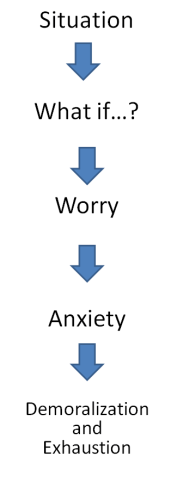
There are several different types of anxiety. One such type is called “generalized anxiety.” People that struggle with generalized anxiety worry more than most people about everyday things, and have trouble controlling it. Generalized anxiety can keep you awake at night or make you feel sick. Sometimes people with generalized anxiety refer to themselves as “worriers.” The Cognitive Model of Generalized Anxiety Disorder, created by Dugas and Robichaud, illustrates the connection between situations, wondering “what if something bad happens?”, worry, anxiety, and demoralization/exhaustion.

So if we accept that worry is not particularly helpful for us, and we want to change this pattern of worrying, what can we do?

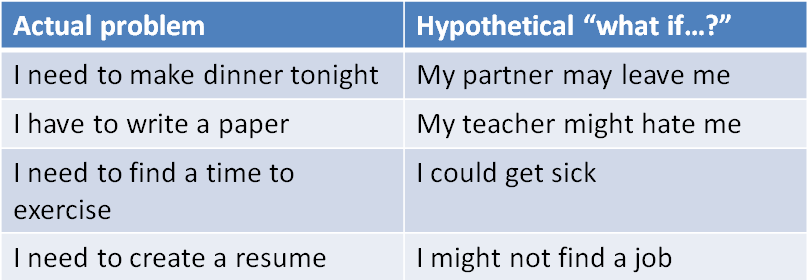
According to many CBT therapists, the first step in overcoming anxiety is understanding our worries. We can do this by writing down what we are worried about several times throughout the day. Then you take this list of worries and divide them into actual current problems and hypothetical “what if…?” worries.


worries

Now you might look at this list and think “but I could get sick!” or “but my partner might leave me!” Yes, but in neither of these situations will worrying help problem solve. You might also look at these lists and think “but my worrying helps motivate me! If I quit worrying, won’t I lose my motivation??” Let me answer this question with a question – many, many, many very motivated and successful people do not worry very much, so why do you have to play by different rules? Also, we can problem solve, set goals, and plan all without worrying, don’t get sucked into the tricks worrying is trying to play on you. One huge difference between the things in the “actual problem” category is that the things on that list are current and actionable. You can choose to make something for dinner, choose to write a paper, choose to schedule a time to exercise, and choose to create a resume. The things on the “what if…?” list are uncertain because they are in the future and greatly influenced by forces beyond your control. It would be a beautiful world if we could just choose to not get sick or choose to have everyone like you.

God grant me the serenity to accept the things I cannot change,

Courage to change the things I can,

And the wisdom to know the difference.

The Serenity Prayer.

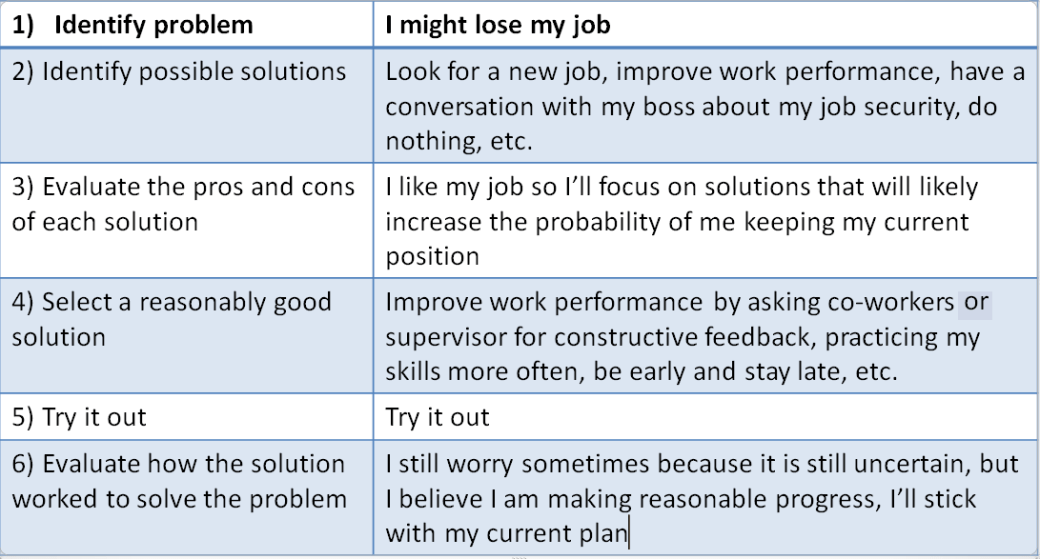
In the sections above, I suggested that worrying is not problem solving, this begs the question “what is problem solving?” In problem solving we first (a) identify the problem, (b) identify possible solutions to a problem, (c) evaluate the pros and cons of each solution, (d) select a reasonably good solution, (e) try it out, (f) evaluate how the solution worked to solve the problem, and (g) repeat this process as necessary. I strongly recommend you write these steps down for your more serious concerns, or chances are when you worry about the problem at 2 in the morning you won’t remember the plan to created yesterday to solve the problem.

problem solving example.PNG

The exercise of identifying which worries are actual problems that we can do something about, from those worries that are beyond our control can be a powerful tool for challenging unhelpful thinking patterns. As we become more aware of these unhelpful patterns, we can replace unhelpful thoughts with more helpful ones. When we think “I might lose my job” we can challenge this worry by thinking “yes, it is possible, however I cannot control this. Instead I’m going to focus on things I can do to decrease the probability of this happening – such as improving my performance.

Unfortunately, there are times where there is nothing we can do to prevent a catastrophe from occurring. In those situations, we are faced with a choice – continue to worry (and suffer) or accept the uncertainty. This can be extremely difficult for some people. One way we can increase our tolerance of the uncertainty is to review the evidence that the catastrophe will take place. What is the evidence the catastrophe has taken place? What are the actual probabilities of the catastrophe occurring? Will your worrying change the probability?

As is usually the case for the topics I choose to write about, this is a huge topic that has been explored in many studies, articles, and books. However, I hope this article helps expand your understanding and will be of some help.

If anyone has any questions or comments, please e-mail!

An introduction to unhelpful thinking styles


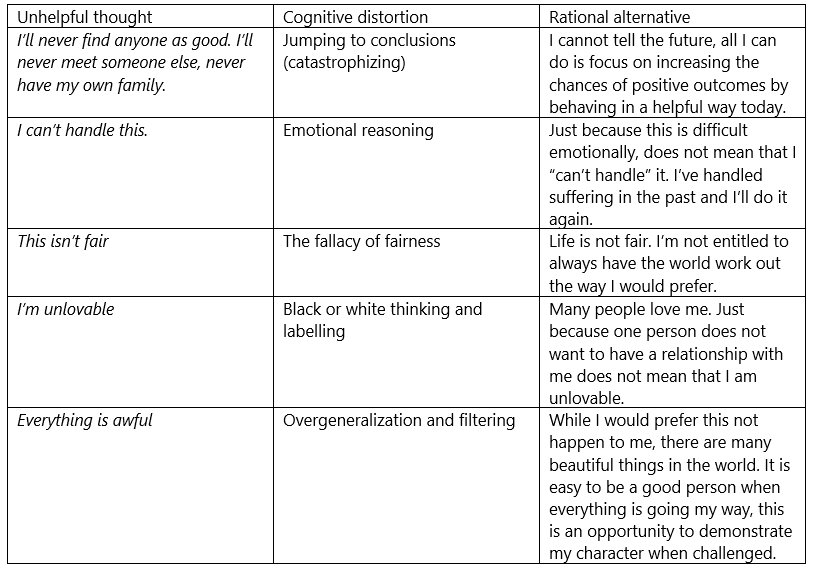
I’ll never find anyone as good. I’ll never meet someone else, never have my own family. I can’t handle this. This isn’t fair. I’m unlovable. Everything is awful.

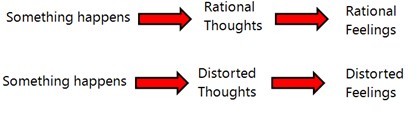
 Most people are familiar with thoughts like these. When under intense stress, like the loss of a significant relationship, our minds often go to those dark places. Sometimes our thoughts are irrational and since these thoughts are extreme, the emotions they evoke are also irrational. I tell clients all the time that I do not want them to be an unfeeling robot. If we suffer a significant loss we should feel some grief, if we are treated unfairly it is normal to feel angry, and it is okay to be sad sometimes. However, sometimes we have emotional reactions which are disproportionate to the situation. It is these intense emotional reactions which usually lead to behavior that is inconsistent with our values and goals. Since we know emotions are caused by thinking, we can reduce the intensity of irrational emotional responses by changing the irrational thinking evoking them.


“There are no facts, only interpretations.”

Friedrich Nietzsche

 Dr. Aaron Beck is widely considered the father of Cognitive Therapy. He was trained in the classical forms of therapy pioneered by Sigmund Freud (Psychodynamic Therapy). Psychodynamic Theory suggests that our thoughts are the product of unconscious or subconscious forces within our psyche. In other words, this theory suggests that our thoughts mean something about us. While at a dinner party, Dr. Beck met a woman and this interaction would change psychotherapy forever. The story is that this woman explained she was depressed and she believed that no one loved her/she was unlovable. Instead of going down the usual therapeutic road, Dr. Beck decided to try something different. He asked her to evaluate the evidence for her beliefs. To her surprise, the woman was able to recognize that there were several people in her life that loved her and when she focused on this, her sadness dissipated (listen to this great podcast for more information). While working with severely depressed patients in his clinic, he noticed several common thinking errors within the thoughts of his patients. Today these thinking errors are called “cognitive distortions.” By identifying and challenging cognitive distortions, our thinking can become more rational and as a result our emotions will also become more rational.

rational thoughts and feelings

In the following table I demonstrate how the “three column technique” can be used to challenge cognitively distorted thoughts. In this exercise you identify your distressing thoughts, identify cognitive distortions taking place, and try and come up with more rational thoughts.

Cog distortions example

While a full description of all of the common cognitive distortions is beyond the scope of a single blog post, I will post a worksheet I use with clients on the self-help resources page that goes over them in greater detail.

When I work with clients, I typically go over a list of some common cognitive distortions. The vast majority of clients are able to recognize that they have many thoughts consistent with these unhelpful thinking styles. Clients struggling with depression usually filter out all of the good things in life, those struggling with anxiety are often plagued with catastrophizing, and people overwhelmed with anger desperately want the world to work the way they want (should/musts and the fallacy of fairness). We all think cognitively distorted thoughts sometimes, it is normal. The refreshing thing about thinking habits is that they can be changed. The first step to changing our thinking is building our awareness of our thoughts. Simply reading this post and the list of common cognitive distortions on the self-help page can help you with becoming more aware of your unhelpful thinking patterns.

Personally, learning about cognitive distortions has changed my life. Challenging my unhelpful thoughts insulates me from distress that comes with being a human being. When I am irrationally frustrated about something (like a hockey game) I pull out my journal and practice these skills. When I go through a more significant challenge (bereavement, financial concerns, trauma, etc.) I use the same skills. Before learning these theories and techniques, I would stay up for hours on end, just laying in bed ruminating about things. Now I am able to process what is going on for me and let it go. Hopefully with some practice, you will be able to do the same.