Behavior and emotions

A fundamental component of Cognitive-Behavioral Therapy is the idea that our thoughts, emotions, and behaviors all influence one another. This is important because it suggests that we can change how we feel by changing how we think and what we do. The connection between thoughts and emotions was somewhat explored in my last post, so today I wanted to focus on the connection between what we do and how we feel.CBT triangle
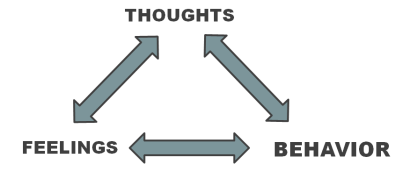
Runners experience a “high” when pushed to their limits, we often feel better after a “good cry”, and we feel pride and satisfaction when we improve at an important task. Conversely, we feel guilty after erupting in anger, we feel sad when we isolate, and we feel anxious when we drink 9 coffees. Therapists typically have an assortment of “relaxation skills” that they teach to their clients to use when they are upset.

When you enter therapy, most therapists will usually assess your sleeping patterns, your diet, your exercise routine, your daily habits, and your hobbies. This is because what you do, greatly impacts how you feel and what you think. Improving self-care can greatly impact a person’s physical and mental health.
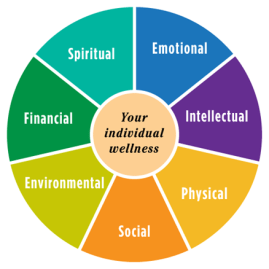
wellness wheelThe question of “how do we lead a healthy life” has been explored by humans for a very long time. Researchers at SFU have been attempting to modernize the very old idea of the “Wellness Wheel.” This model breaks down the concept of wellness into seven primary dimensions Simply put, we can improve our wellness by attempting to maintain balance among these dimensions. I suspect most people can anticipate how their well-being would suffer if they were to over focus on one dimension at the cost of the others.(http://www.sfu.ca/students/health/resources/wellness/wheel.html).

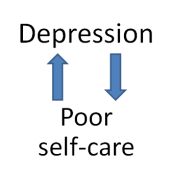
In my opinion, few examples illustrate the connection between emotions and behavior paradox of depressionbetter than the behavior habits of depressed people. When you ask a person with depression about their daily routines, it is not unusual in my experience for them to describe a daily routine dominated by social withdrawal, minimal exercise, low goal-oriented behavior, unhealthy eating habits, and irregular sleeping patterns. Paradoxically, depression often reduces self-care which in turn feeds depression. I’ve often believed that if we were to take a mentally “healthy” person and force them to behave the same way as a depressed person, it would only be a matter of time before the despair, sadness, and loneliness set in. Regardless of what came first, research suggests we can reduce feelings of depression by improving self-care.
Behavioral Activation (BA) is a strategy for combatting depression that has over 40 years of research supporting it. Eight common techniques used in BA are (1) Activity monitoring, (2) value and goal assessment, (3) activity scheduling, (4) skills training, (5) relaxation skills, (6) contingency management, (7) procedures targeting verbal behavior, and (8) procedures targeting avoidance. BA techniques can help challenge the belief that we are victims to our moods, that we can’t do what is good for us until we feel better. These techniques can demonstrate that sometimes we can “fake it to we make it.” Please see the “Self-Help Resources” page for more information about BA.

This idea that there is a connection between our mood and our behavior can benefit anyone, not just those with clinical depression. The cliché’ and famous Einstein quote is “the definition of insanity is doing the same thing over and over and expecting different results.” By that logic, can we really expect our mood to change when we are unwilling to change what we are doing (or thinking)?


Please feel free to e-mail me with any questions or comments.

What causes emotions and how do we change how we feel?

Our thoughts, beliefs, assumptions, and interpretations cause emotions. At least that’s what cognitive therapists think. Some people have a very difficult time accepting this, but stick with me here. Many people believe that situations or other people cause their emotions. These people talk to their friends and say things like “he just makes me so mad!”, “how can I be happy when ____________ is wrong with my life?”, or “I’d never have any road rage if people could just learn to drive.” While it is true that situations influence our feelings, it is what we think about those situations that cause our emotional reactions to those situations. Take for example, two people who have recently gone through a divorce. Assume for the purposes of this example, their situations are exactly the same. The first divorce’ feels overwhelmed with depression, guilt, and shame because they think: this is the worst thing that could happen. I’ll be alone forever. No one will ever love me. I’m too old to start a relationship. This is going to ruin life for my kids. The second divorce’ has a radically different emotional reaction because they think: In all honesty I was generally unhappy in that relationship, this is an opportunity for me to invest my time and energy into something more satisfying. This is difficult and it is unfortunate that this did not work out but just because it wasn’t a good fit with my last partner does not mean it won’t work out with other people in the future.

“But what about brain chemicals??? Aren’t our emotions a reflection of the levels of neurochemicals in our brains?” First, it is true that the levels of certain neurotransmitters are associated with the likelihood of experiencing particular emotions. This is why medications like selective serotonin reuptake inhibitors (SSRIs) can help reduce depression for some people. However, your neurochemistry is greatly influenced by what you do and how you think. Therefore, you can change your neurotransmitter levels by changing what you do and how you think.

It is still okay if you are still unconvinced that your emotions are created by your thoughts, beliefs, assumptions, and interpretations. If your are still skeptical let me ask you this – even if 99% of your suffering is caused by your brain chemistry, other people, or situations, isn’t it more productive to focus on that 1% you can control? What is helpful for you? Is it helpful to believe that you are a powerless victim without any choices?


Alright so if we accept that our emotions are caused by our thinking, how does this help us? It means that we can change how we feel by changing how we think. Many types of therapy rely on thought replacement to do this.

The first step of thought replacement is building awareness about the thoughts causing your emotional reactions. These automatic thoughts (or “hot thoughts”) can be in the form of language (“I’m an idiot”) or in the form of images/fantasies, and they automatically pop into our minds when we are in moments of crisis. Unfortunately, we usually just accept our automatic thoughts to be true. This is unfortunate because often our thoughts are just dramatic nonsense.

Once we are aware of our automatic thoughts we try and assess the degree to which these thoughts are realistic or factual. Dr. Beck (the founder of cognitive therapy) recommends three questions to do this: (1) what’s the evidence that this thought is true or false? (2) What might be another way of looking at the situation? And (3) so what if this thought is true? Challenging our automatic thoughts can be very difficult at first (this is one of the reasons I have a job) because we usually have a lot of practice just accepting our opinions, interpretations, and assumptions as facts.

If we come to find that our thoughts are not realistic or factual we move into the third step of thought replacement – focusing on a more rational alternative. It is usually not enough to simply deny the validity of a thought, we usually have to focus on another thought to take its place. Our focus is like a laser pointer, we can point it at one thing at a time. Sometimes it feels like several things because we are frantically moving the laser pointer from one thing to the next. With practice we can choose to focus our attention on the more rational alternative and let the negative automatic thought go. However, we do not stop there. How do we know that the new alternative thought is more realistic or factual? We test out the new thought in the real world. In science terms – we test our new hypothesis and try and see if it is supported by evidence.

So to go back to my example of the first divorce’ who feels overwhelmed with depression, guilt, and shame. First we (1) identify a negative automatic thought that is contributing to their suffering – “I’ll be alone forever.” Then we (2) assess the degree to which this thought is realistic or factual by asking those three questions posed by Dr. Beck. What’s the evidence? Many people who go through divorce end up in even better relationships. What’s another way of look at the situation? This is an opportunity for me to invest my time and energy into something more satisfying. This is difficult and it is unfortunate that this did not work out but just because it wasn’t a good fit with my last partner does not mean it won’t work out with other people in the future. So what if this thought is true? The world would not end. My happiness is not dependent on my being in a relationship. While it is unlikely I’ll be alone forever, there is still a lot of joy to have in the world. Finally, we then (3) focus on a more rational alternative – I would have preferred to have been in a perfect marriage on my first try but I am not entitled to have everything I want. It is easy to be a kind, respectful, and loving person when everything is going my way, this is an opportunity for me to display the depth of my character when challenged to my children. Just because one relationship did not work out does not mean that I am unlovable or that I will be alone forever. What can I focus on improving about myself so I can increase the chances of meeting my goals in the future?

I am very aware that these principles are easier said than done. I do not mean to suggest any of this is easy. Thousands of journal articles and books have been written on these topics and this is only a very brief overview. I’ve had to use these skills many, many times in my life and they have been an immense help for me. My only hope with this post is that perhaps it may be helpful for you as well.

The influence of behaviour on emotions will be explored in more depth in future posts.


South Island Wellness

South Island Wellness brings resources from around the world to the South Vancouver Island area to enhance your personal wellbeing. These resources include blog posts, links to helpful materials online, and information that can be used to connect you with registered clinical counselling in the South Vancouver Island area.

Health and Wellbeing

Here is a portion from my Master’s Thesis on health and wellbeing:

Health and wellbeing are multidimensional and overlapping constructs.  Health is a multicomponent concept: “a state of complete physical, mental and social wellbeing and not merely the absence of disease or infirmity” (WHO, 2006).  The World Health Organization has not changed this definition of health from 1948 when the WHO Constitution entered into force, and retains this definition on its website today.  The WHO definition of health aligns closely with the definition of wellness endorsed by the National Wellness Institute (n.d.): “Wellness is holistic and multidimensional, encompassing physical, mental, social, and spiritual wellbeing.”  Wellness, according to the National Wellness Institute (n.d.), is a positive and affirming state of being and functioning.  Seligman (2011) has developed a model of wellness, defining and characterizing wellness as comprising—and requiring—the cultivation of five, what I might call, ways of relating to life and living, namely: the cultivation of (a) positive emotion; (b) engagement; (c) relationship, (d) meaning; and (e) achievement.  Wong (2015) said that wellness is an effortful and intentional process “involving personal responsibility and commitment” (p.1).

Self-perceived or subjective wellbeing is an evaluation of life as a whole in terms of overall happiness and the pleasantness of life (Diener, Emmons, Larsen, & Griffin 1985); the hedonic balance between positive and negative affective appraisals and (more cognitively driven) life-satisfaction (Chen et al., 2012; Corrigan, 2000).  Indeed, life-satisfaction is used in empirical studies as an indicator of subjective wellbeing (Mcdowell, 2006, p. 206).  Subjective wellbeing has a bidirectional relationship with health in general, possibly even contributing to its maintenance (Steptoe, Deaton, & Stone, 2015).  The literature has hotly debated the distinction between subjective and psychological wellbeing (e.g., Chen et al., 2012).  Psychological wellbeing is defined as the capacity to feel, think, and act in ways that enhance our inherent abilities to realize our self-potential (Chen et al., 2012), to enjoy life, and to deal with the inevitable and unavoidable adversities and challenges of life (Wong, 2015).  Experientially, psychological wellbeing is a sense of composure or (for some) spiritual wellbeing, and is the antithesis of feelings, and behavioural and physiological symptoms, of distress (parentheses are mine; Wong, 2015).  Interestingly, in their 2015 review paper of the associations between subjective wellbeing, health, and age Steptoe and colleagues (2015) collapsed across the hedonic and eudemonic distinctions, defining subjective wellbeing as comprising evaluative wellbeing (or life satisfaction), hedonic wellbeing (feelings of happiness, sadness, anger, stress, and pain), and eudemonic wellbeing (sense of purpose and meaning in life).  In collapsing across hedonic and eudemonic distinctions, I think Steptoe et al. have more fully captured the human condition within the human (subjective) experience of wellbeing.

Psychological distress is a common-sense index of general health and wellbeing.  Psychological distress is mental and social suffering in response to unmet needs, demanding life circumstances (Ridner, 2004), traumatic life events, or existential concerns.  Psychological distress is a sense of discomfort and distress accompanied subjectively by one or more of demoralization and pessimism towards the future, anguish and stress, self-depreciation, social withdrawal and isolation, somatization, and withdrawal into oneself (Masseé, 2000).  A defining and signal characteristic of psychological distress is that it does harm, either temporary or permanent, to the person (Ridner, 2004).